| |
Date |
Event(s) |
| 1 | 1727 | - 11 Jun 1727—25 Oct 1760: King George II's reign
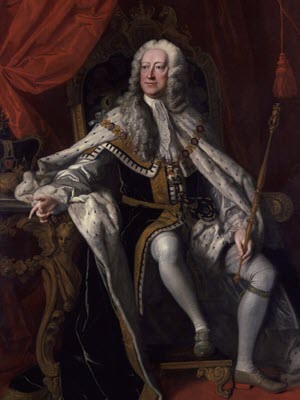
George IIexercised little control over British domestic policy, which was largely controlled by the Parliament of Great Britain. As elector, he spent twelve summers in Hanover, where he had more direct control over government policy.
During the War of the Austrian Succession, George participated at the Battle of Dettingen in 1743, and thus became the last British monarch to lead an army in battle. In 1745, supporters of the Catholic claimant to the British throne, James Francis Edward Stuart ("The Old Pretender"), led by James's son Charles Edward Stuart ("The Young Pretender" or "Bonnie Prince Charlie"), attempted and failed to depose George in the last of the Jacobite rebellions.
|
| 2 | 1756 | - 16 Nov 1756—29 Jun 1757: Duke of Devonshire - 5th British Prime Minister

William Cavendish, 4th Duke of Devonshire, styled Lord Cavendish before 1729 and Marquess of Hartington between 1729 and 1755, was a British Whig statesman and nobleman who was briefly nominal Prime Minister of Great Britain. The Seven Years' War was going badly for Britain under the leadership of the Duke of Newcastle and when he resigned in October 1756, George II eventually asked Devonshire to form an administration. Devonshire accepted on the condition that his tenure would last only until the end of the parliamentary session. Devonshire believed his duty to the King required an administration capable of prosecuting the war successfully.
|
| 3 | 1757 | - 29 Jun 1757—26 May 1762: Duke of Newcastle - 6th British Prime Minister

Thomas Pelham-Holles, 1st Duke of Newcastle upon Tyne and 1st Duke of Newcastle-under-Lyme, was a British Whig statesman, whose official life extended throughout the Whig supremacy of the 18th century. He is commonly known as the Duke of Newcastle. Historian Harry Dickinson says that he became, "Notorious for his fussiness and fretfulness, his petty jealousies, his reluctance to accept responsibility for his actions, and his inability to pursue any political objective to his own satisfaction or to the nations profit ... Many modern historians have depicted him as the epitome of unredeemed mediocrity and as a veritable buffoon in office."
|
Webmaster Message
I make every effort to document my research. If you have something you would like to add, please contact me.


 1757 - 1757

