| |
Date |
Event(s) |
| 1 | 1689 | - 13 Feb 1689—8 Mar 1702: King William III's reign

William III, supported by a group of influential British political and religious leaders, invaded England in what became known as the "Glorious Revolution," landing at the southern English port of Brixham. James was deposed and William and his wife became joint sovereigns. William and Mary reigned together until Mary's death on 28 December 1694, after which William ruled as sole monarch.
William's reputation as a staunch Protestant enabled him to take power in Britain when many were fearful of a revival of Catholicism. Hiss victory at the Battle of the Boyne in 1690 is still commemorated by loyalists in Northern Ireland and Scotland. His reign marked the beginning of the transition from the personal rule of the Stuarts to a more Parliament-centred rule
|
| 2 | 1702 | - 8 Mar 1702—1 Aug 1714: Queen Anne's reign
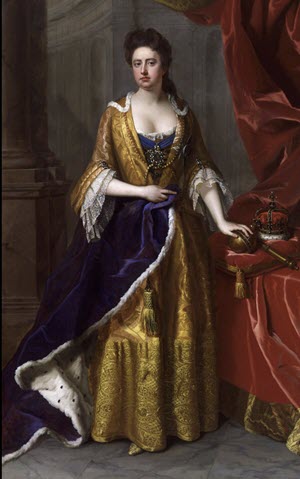
Queen Anne, the second daughter of James II, Anne was a staunch, high church Protestant. During her reign Britain became a major military power and the foundations were laid for the 18th century’s Golden Age.
Anne was plagued by ill health throughout her life, and from her thirties, she grew increasingly ill and obese. Despite seventeen pregnancies by her husband, Prince George of Denmark, she died without surviving issue and was the last monarch of the House of Stuart. Under the Act of Settlement 1701, which excluded all Catholics, she was succeeded by her second cousin George I of the House of Hanover.
|
Webmaster Message
I make every effort to document my research. If you have something you would like to add, please contact me.


 1698 - 1703 (4 years)

