| |
Date |
Event(s) |
| 1 | 1553 | - 19 Jul 1553—17 Nov 1558: Queen Mary I's reign

Mary I is best known for her aggressive attempt to reverse the English Reformation, which had begun during the reign of her father, Henry VIII. The executions that marked her pursuit of the restoration of Roman Catholicism in England and Ireland led to her denunciation as "Bloody Mary" by her Protestant opponents.
During her five-year reign, Mary had over 280 religious dissenters burned at the stake in the Marian persecutions. After Mary's death in 1558, her re-establishment of Roman Catholicism was reversed by her younger half-sister and successor Elizabeth I, daughter of Henry and Anne Boleyn, at the beginning of the 45-year Elizabethan Era.
|
| 2 | 1554 | - 25 Jul 1554—17 Nov 1558: King Philip's reign
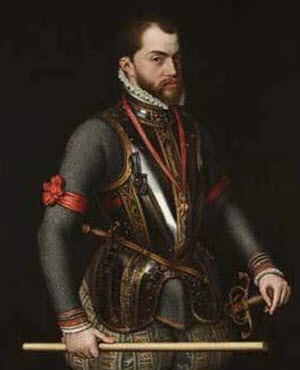
Under the terms of the marriage treaty between Philip I of Naples and Queen Mary I, he was to enjoy Mary's titles and honours for as long as their marriage lasted. An Act of Parliament gave him the title of king and stated that he "shall aid her Highness … in the happy administration of her Grace's realms and dominions" (although elsewhere it said Mary was to be "sole queen").
|
| 3 | 1558 | - 17 Nov 1558—24 Mar 1603: Queen Elizabeth I's reign

Elizabeth I was also known as The Virgin Queen, Gloriana or Good Queen Bess. She was the last of the five monarchs of the House of Tudor.
Elizabeth's reign became known as the Elizabethan era. The period is famous for the flourishing of English drama, led by playwrights such as William Shakespeare and Christopher Marlowe, and for the seafaring prowess of English adventurers such as Francis Drake. After the short reigns of her half-siblings, her 44 years on the throne provided welcome stability for the kingdom and helped forge a sense of national identity
|
| 4 | 1564 | - 1564: William Shakespeare's birth

William Shakespeare became a renowned English poet, playwright, and actor. His work includes 38 plays, 2 narrative poems, 154 sonnets, and other poems. No original manuscripts of Shakespeare's plays exist. A group of actors from Shakespeare's company collected about half for publication after Shakespeare died. From the various documents that have survived we know that he spelled his last name in various ways, none of which was "Shakespeare"
|
| 5 | 1585 | - 1585: Roanoke Community founded
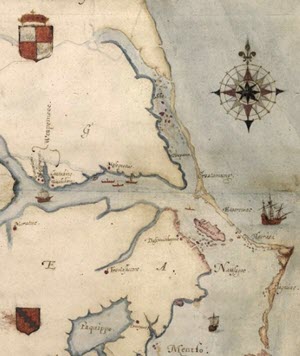
The Roanoke Colony, was the first attempt at founding a permanent English settlement in North America. It was established on Roanoke Island in what is today's Dare County, North Carolina. The colony was sponsored by Sir Walter Raleigh, although he himself never set foot in it. A lack of supplies and bad relations with the local Native Americans caused many of its members to return to England with Sir Francis Drake a year later, leaving behind a small detachment who had all disappeared by the time a second expedition arrived in July 1587.
|
| 6 | 1588 | - Jul 1588—8 Aug 1588: Spanish Armada
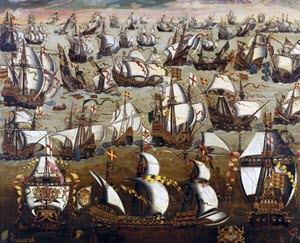
The Spanish Armada was a fleet of 130 ships with the purpose of escorting an army from Flanders to invade England. The strategic aim was to overthrow Queen Elizabeth I and her establishment of Protestantism in England.
The Armada chose not to attack the English fleet at Plymouth and dropped anchor off Calais. It was scattered by an English fireship attack. In the ensuing battle the Spanish fleet was damaged. They managed to regroup and, driven by southwest winds, withdrew north, with the English fleet harrying them up the east coast of England. The Armada was disrupted during severe storms in the North Atlantic and a large number of the vessels were wrecked on the coasts of Scotland and Ireland. Of the initial 130 ships over a third failed to return. The following year, England organised a "counter-Armada", which was also unsuccessful.
|
| 7 | 1600 | - 1600: East India Company Founded

The East India Company (EIC) was the largest and most powerful company that the world has ever seen.
Modern comparisons don't even come close. Apple Inc, and Microsoft who jostle for #1 with a value of around $800 billion each, are both dwarfed by East India's comparative value of $7.91 trillion - at a time when the world population was only around 680 million, compared to 7.7 billion in 2018. The EIC generated ten times the revenue with only one tenth of the population!
|
| 8 | 1603 | - 24 Mar 1603—27 Mar 1625: King James I's reign

Elizabeth I was the last of Henry VIII's descendants, and James I was seen as her most likely heir through his great-grandmother Margaret Tudor, who was Henry VIII's oldest sister. From 1601, English politicians—notably her chief minister Sir Robert Cecil - maintained a secret correspondence with James to prepare in advance for a smooth succession. With the Queen clearly dying, Cecil sent James a draft proclamation of his accession to the English throne in March 1603. Elizabeth died in the early hours of 24 March, and James was proclaimed king in London later the same day.
On 5 April, James left Edinburgh for London, promising to return every three years (a promise that he did not keep), and progressed slowly southwards, arriving in the capital on 7 May, nine days after Elizabeth's funeral. His new subjects flocked to see him, relieved that the succession had triggered neither unrest nor invasion.
|
| 9 | 1605 | - 5 Nov 1605: Gunpowder Plot

The Gunpowder Plot was a failed assassination attempt against King James I by a group of provincial English Catholics led by Robert Catesby.
The plan was to blow up the House of Lords during the State Opening of Parliament on 5 November , as the prelude to a popular revolt in the Midlands during which James's nine-year-old daughter, Elizabeth, was to be installed as the Catholic head of state. Catesby may have embarked on the scheme after hopes of securing greater religious tolerance under King James had faded, leaving many English Catholics disappointed. His fellow plotters were John and Christopher Wright, Robert and Thomas Wintour, Thomas Percy, Guy Fawkes, Robert Keyes, Thomas Bates, John Grant, Ambrose Rookwood, Sir Everard Digby and Francis Tresham. Fawkes, who had 10 years of military experience , was given charge of the explosives.
|
| 10 | 1607 | - 14 May 1607: Jamestown founded

The Jamestown settlement in the Colony of Virginia was the first permanent English settlement in the Americas. It was located on the east bank of the Powhatan (James) River about 2.5 mi (4 km) southwest of the center of modern Williamsburg. William Kelso writes that Jamestown "is where the British Empire began".
It was established by the Virginia Company of London as "James Fort" on May 4, 1607 and was considered permanent after brief abandonment in 1610. It followed several failed attempts, including the Lost Colony of Roanoke, established in 1585 on Roanoke Island. Jamestown served as the capital of the colony of Virginia for 83 years, from 1616 until 1699.
|
| 11 | 1608 | - 3 Jul 1608: Founding of Québec

Samuel de Champlain established a fortified trading post at Québec, the perfect location to foster the fur trade and to serve as the base for its founder's idea of colonizing the remote country.
Text and image © The Canadian Encyclopedia
|
| 12 | 1620 | - 1620: The Pilgrim Fathers set sail
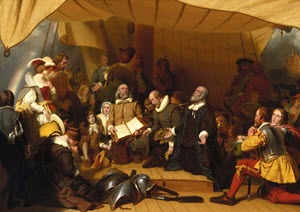
The Pilgrim Fathers set sail to the Americas on the Mayflower from Plymouth in Devon. Conventional wisdom is that the pilgrims fled England to escape religious persecution. The more realistic truth is that as a radical sect the pilgrims were unable to impose their views on the established church, and left voluntarily
- 1620: Plymouth Rock

Plymouth Rock is the traditional disembarkation site of the Mayflower Pilgrims. More recently the idea has been questioned. Journalist Bill Bryson wrote, "The one thing the Pilgrims did not do was step ashore on Plymouth Rock," because the boulder would have made an impractical landing spot. Others have said the Pilgrims first disembarked from the Mayflower at Provincetown, Massachusetts
|
| 13 | 1625 | - 27 Mar 1625—30 Jan 1649: King Charles I's reign

Charles I was king of England, Scotland and Ireland, whose conflicts with parliament led to civil war and his eventual execution.
Charles's reign was plagued with tensions with parliament over money - made worse by the costs of war abroad. In addition, Charles favoured a High Anglican form of worship, and his wife was Catholic - both made many of his subjects suspicious, particularly the Puritans. In November 1641, tensions were raised even further with disagreements over who should command an army to suppress an uprising in Ireland. Charles attempted to have five members of parliament arrested and in August 1642, raised the royal standard at Nottingham. Civil war began.
The Royalists were defeated by the Scots and the formation of the New Model Army. Convinced that there would never be peace while the king lived, a rump of radical MPs, including Cromwell, put him on trial for treason. He was found guilty and executed on 30 January 1649 outside the Banqueting House on Whitehall, London.
|
Webmaster Message
I make every effort to document my research. If you have something you would like to add, please contact me.


 1555 - 1628 (73 years)

