| |
Date |
Event(s) |
| 1 | 1558 | - 17 Nov 1558—24 Mar 1603: Queen Elizabeth I's reign

Elizabeth I was also known as The Virgin Queen, Gloriana or Good Queen Bess. She was the last of the five monarchs of the House of Tudor.
Elizabeth's reign became known as the Elizabethan era. The period is famous for the flourishing of English drama, led by playwrights such as William Shakespeare and Christopher Marlowe, and for the seafaring prowess of English adventurers such as Francis Drake. After the short reigns of her half-siblings, her 44 years on the throne provided welcome stability for the kingdom and helped forge a sense of national identity
|
| 2 | 1585 | - 1585: Roanoke Community founded
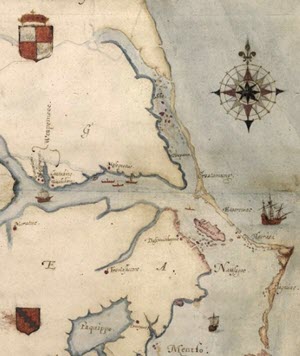
The Roanoke Colony, was the first attempt at founding a permanent English settlement in North America. It was established on Roanoke Island in what is today's Dare County, North Carolina. The colony was sponsored by Sir Walter Raleigh, although he himself never set foot in it. A lack of supplies and bad relations with the local Native Americans caused many of its members to return to England with Sir Francis Drake a year later, leaving behind a small detachment who had all disappeared by the time a second expedition arrived in July 1587.
|
| 3 | 1588 | - Jul 1588—8 Aug 1588: Spanish Armada
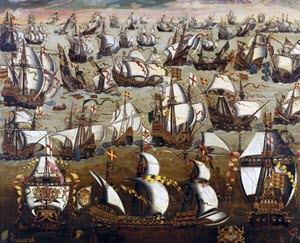
The Spanish Armada was a fleet of 130 ships with the purpose of escorting an army from Flanders to invade England. The strategic aim was to overthrow Queen Elizabeth I and her establishment of Protestantism in England.
The Armada chose not to attack the English fleet at Plymouth and dropped anchor off Calais. It was scattered by an English fireship attack. In the ensuing battle the Spanish fleet was damaged. They managed to regroup and, driven by southwest winds, withdrew north, with the English fleet harrying them up the east coast of England. The Armada was disrupted during severe storms in the North Atlantic and a large number of the vessels were wrecked on the coasts of Scotland and Ireland. Of the initial 130 ships over a third failed to return. The following year, England organised a "counter-Armada", which was also unsuccessful.
|
| 4 | 1600 | - 1600: East India Company Founded

The East India Company (EIC) was the largest and most powerful company that the world has ever seen.
Modern comparisons don't even come close. Apple Inc, and Microsoft who jostle for #1 with a value of around $800 billion each, are both dwarfed by East India's comparative value of $7.91 trillion - at a time when the world population was only around 680 million, compared to 7.7 billion in 2018. The EIC generated ten times the revenue with only one tenth of the population!
|
| 5 | 1603 | - 24 Mar 1603—27 Mar 1625: King James I's reign

Elizabeth I was the last of Henry VIII's descendants, and James I was seen as her most likely heir through his great-grandmother Margaret Tudor, who was Henry VIII's oldest sister. From 1601, English politicians—notably her chief minister Sir Robert Cecil - maintained a secret correspondence with James to prepare in advance for a smooth succession. With the Queen clearly dying, Cecil sent James a draft proclamation of his accession to the English throne in March 1603. Elizabeth died in the early hours of 24 March, and James was proclaimed king in London later the same day.
On 5 April, James left Edinburgh for London, promising to return every three years (a promise that he did not keep), and progressed slowly southwards, arriving in the capital on 7 May, nine days after Elizabeth's funeral. His new subjects flocked to see him, relieved that the succession had triggered neither unrest nor invasion.
|
| 6 | 1605 | - 5 Nov 1605: Gunpowder Plot

The Gunpowder Plot was a failed assassination attempt against King James I by a group of provincial English Catholics led by Robert Catesby.
The plan was to blow up the House of Lords during the State Opening of Parliament on 5 November , as the prelude to a popular revolt in the Midlands during which James's nine-year-old daughter, Elizabeth, was to be installed as the Catholic head of state. Catesby may have embarked on the scheme after hopes of securing greater religious tolerance under King James had faded, leaving many English Catholics disappointed. His fellow plotters were John and Christopher Wright, Robert and Thomas Wintour, Thomas Percy, Guy Fawkes, Robert Keyes, Thomas Bates, John Grant, Ambrose Rookwood, Sir Everard Digby and Francis Tresham. Fawkes, who had 10 years of military experience , was given charge of the explosives.
|
Webmaster Message
I make every effort to document my research. If you have something you would like to add, please contact me.


 1576 - 1605 (29 years)

