| |
Date |
Event(s) |
| 1 | 1835 | - 18 Apr 1835—30 Aug 1841: Viscount Melbourne - 30th British Prime Minister

William Lamb, 2nd Viscount Melbourne, (15 March 1779 – 24 November 1848) was a British Whig statesman who served as Home Secretary (1830–1834) and Prime Minister (1834 and 1835–1841). He is best known for his intense and successful mentoring of Queen Victoria in the ways of politics, when she was between the ages of 18 and 21. Historians have concluded that Melbourne does not rank highly as a Prime Minister, for there were no great foreign wars or domestic issues to handle, he lacked major achievements, and he enunciated no grand principles. "But he was kind, honest and not self-seeking."
Melbourne was Prime Minister on two occasions. The first ended when he was dismissed by King William IV in 1834, the last British prime minister to be dismissed by a monarch. Six months later he was re-appointed and served for six years.
|
| 2 | 1837 | - 4 Mar 1837—4 Mar 1841: Martin Van Buren - 8th US President

Martin Van Buren (December 5, 1782 – July 24, 1862) was the eighth president of the United States from 1837 to 1841. A founder of the Democratic Party, he previously served as the ninth governor of New York, the tenth U.S. secretary of state, and the eighth vice president of the United States. He won the 1836 presidential election with the endorsement of popular outgoing President Andrew Jackson and the organizational strength of the Democratic Party.
The president proposed the establishment of an independent US treasury, which he contended would take the politics out of the nation's money supply. Under the plan, the government would hold all of its money balances in the form of gold or silver, and would be restricted from printing paper money at will; both measures were designed to prevent inflation. The plan would permanently separate the government from private banks by storing government funds in government vaults rather than in private banks
- 20 Jun 1837—22 Jan 1901: Queen Victoria's reign

Victoria was Queen of the United Kingdom of Great Britain and Ireland from 20 June 1837 until her death. On 1 May 1876, she adopted the additional title of Empress of India.
Victoria inherited the throne at the age of 18, after her father's three elder brothers had all died leaving no surviving legitimate children. She became a national icon who was identified with strict standards of personal morality. Victoria married her first cousin Prince Albert. After his death in 1861, Victoria plunged into deep mourning and avoided public appearances. As a result, republicanism temporarily gained strength but in the latter half of her reign, her popularity recovered. Her Golden and Diamond Jubilees were times of public celebration.
|
| 3 | 1840 | - 1840: Houses of Parliament

More correctly known as the Palace of Westminster, the Houses of Parliament are the meeting places of the Houses of Commons and Lords. The name is from the neighbouring Westminster Abbey.While the present buildings make look as though they date from the Gothic Period of the 14th and 15th Centuries, they were built between 1840 and 1870 following the 1834 fire
- 1840: British Migration to New Zealand begins

British Migration to New Zealand: In early 19th C, Britain conditions were such that millions set off for the New World. By 1839 there were only 2,000 immigrants in New Zealand, by 1852, 28,000. The decisive moment for this change was 1840 when the Treaty of Waitangi was signed. This established British authority in European eyes, and gave British immigrants legal rights as citizens. The treaty helped ensure that for 100+ years, most immigrants would come from the UK
|
| 4 | 1841 | - 4 Feb 1841—4 Apr 1841: William Henry Harrison - 9th US President

William Henry Harrison Sr. (February 9, 1773 – April 4, 1841) was an American military officer, politician, and the ninth president of the United States. He died of pneumonia thirty-one days into his term, thereby serving the shortest tenure in United States presidential history. Because he was the first president to die in office, his death sparked a constitutional crisis and questions and debates about the presidential line of succession.
He took the oath of office on Thursday, March 4, 1841, a cold and wet day. He wore neither an overcoat nor hat, rode on horseback to the ceremony rather than in the closed carriage that had been offered him, and delivered the longest inaugural address in American history, at 8,445 words
- 4 Apr 1841—4 Mar 1845: John Tyler - 10th US President

John Tyler (March 29, 1790 – January 18, 1862) was the tenth president of the United States from 1841 to 1845 after briefly being the tenth vice president (1841); he was elected to the latter office on the 1840 Whig ticket with President William Henry Harrison.
Tyler ascended to the presidency after Harrison's death in April 1841, only a month after the start of the new administration. He was a supporter of states' rights, and as president he adopted nationalist policies only when they did not infringe on the powers of the states.
- 30 Aug 1841—29 Jun 1846: Robert Peel - 31st British Prime Minister

Sir Robert Peel, 2nd Baronet, (5 February 1788 – 2 July 1850) was a British statesman and Conservative Party politician who served twice as Prime Minister of the United Kingdom (1834–35 and 1841–46) and twice as Home Secretary (1822–27 and 1828–30). He is regarded as the father of modern British policing and as one of the founders of the modern Conservative Party.
His second government ruled for five years. He cut tariffs to stimulate trade; to replace the lost revenue he pushed through a 3% income tax. He played a central role in making free trade a reality and set up a modern banking system.
|
| 5 | 1842 | - 1842: Income Tax
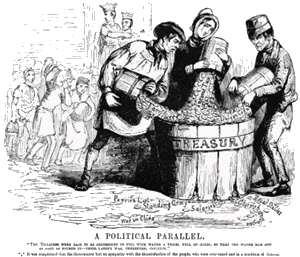
Following the end of the Napoleonic War in 1815, the public mood of compliance with income tax rapidly evaporated. The government wanted to retain it to help reduce the National Debthowever, strong public opposition to the tax was demonstrated by landowners, merchants, manufacturers, bankers, and tradesmen. On 18 March 1816, the government was narrowly defeated on the issue and was forced to abandon it.
By the early 1840s business opinion had moved towards 'free trade' and the removal of high protective duties on imports and exports. Sir Robert Peel, the Prime Minister, was keen to facilitate this thinking. In 1842, therefore, he re-introduced income tax at 7d in the pound on incomes over £150. This allowed him to remove import and export duties on more than 700 items.
- 1842: First Chemical Fertiliser

Sir John Bennet Lawes, 1st Baronet, FRS (28 December 1814 – 31 August 1900) was an English entrepreneur and agricultural scientist. He founded an experimental farm at his home at Rothamsted Manor that eventually became the Rothamsted Experimental Station, where he developed and, in 1842, patented a superphosphate that would mark the beginnings of the chemical fertilizer industry
|
| 6 | 1843 | - 1843: SS Great Britain Launched
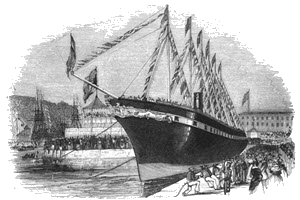
SS Great Britain is a museum ship and former passenger steamship, and was advanced for her time. She was the longest passenger ship in the world from 1845 to 1854. She was designed by Isambard Kingdom Brunel (1806–1859), for the Great Western Steamship Company's transatlantic service between Bristol and New York. While other ships had been built of iron or equipped with a screw propeller, the Great Britain was the first to combine these features in a large ocean-going ship. She was the first iron steamer to cross the Atlantic, which she did in 1845, in 14 days.
|
Webmaster Message
I make every effort to document my research. If you have something you would like to add, please contact me.


 1840 - 1843 (3 years)

