| |
Date |
Event(s) |
| 1 | 1760 | - 25 Oct 1760—29 Jan 1820: King George III's reign

George III was the third British monarch of the House of Hanover, but unlike his two predecessors, he was born in Great Britain, spoke English as his first language, and never visited Hanover. His reign was marked by a series of military conflicts involving his kingdoms, much of the rest of Europe, and places farther afield. Early in his reign, Great Britain defeated France in the Seven Years' War, becoming the dominant European power in North America and India. However, many of Britain's American colonies were soon lost in the American War of Independence. Further wars against revolutionary and Napoleonic France from 1793 concluded in the defeat of Napoleon at the Battle of Waterloo in 1815.
Later in life, George III had recurrent mental illness. After a final relapse in 1810, a regency was established, and George III's eldest son, George, Prince of Wales, ruled as Prince Regent.
|
| 2 | 1803 | - 1803—1815: Napoleonic Wars

The Napoleonic Wars were a series of major conflicts pitting the French Empire and its allies, led by Napoleon I, against a fluctuating array of European powers formed into various coalitions, financed and usually led by the United Kingdom. The wars stemmed from the unresolved disputes associated with the French Revolution and its resultant conflict
|
| 3 | 1809 | - 4 Mar 1809—4 Mar 1817: James Madison - 4th US President

James Madison Jr (March 16, 1751 – June 28, 1836)[1] was an American statesman and Founding Father who served as the fourth president of the United States from 1809 to 1817. He is hailed as the "Father of the Constitution" for his pivotal role in drafting and promoting the United States Constitution and the Bill of Rights.
After the failure of diplomatic protests and a trade embargo against the United Kingdom, he led the US into the War of 1812. The war was an administrative morass, as the United States had neither a strong army nor a robust financial system. As a result, Madison came to support a stronger national government and military, as well as the national bank, which he had long opposed. Historians have generally ranked Madison as an above-average president.
- 4 Oct 1809—11 May 1812: Spencer Perceval - 21st British Prime Minister

Spencer Perceval (1 November 1762 – 11 May 1812) was a British statesman who served as Prime Minister of the United Kingdom from October 1809 until his assassination in May 1812.[1] Perceval is the only British prime minister to have been murdered. He was also the only Solicitor General or Attorney General to become Prime Minister.
Perceval faced a number of crises during his term in office, including an inquiry into the Walcheren expedition, the madness of King George III, economic depression and Luddite riots. He overcame these crises, successfully pursued the Peninsular War in the face of opposition defeatism, and won the support of the Prince Regent. His position was looking stronger by early 1812, when, in the lobby of the House of Commons, he was assassinated by a merchant with a grievance against his government.
|
| 4 | 1811 | - 12 Jun 1811: Selkirk's Red River Grant

The Hudson's Bay Company granted an area of about 185 000 km² to Lord Selkirk for formation of a colony at Red River. His first settlers arrived in the summer of 1812. Despite tribulations the settlement grew into the first European colony in the North-West.
Text and image © The Canadian Encyclopedia
|
| 5 | 1812 | - 1812: Charles Dickens

Charles Dickens is famous for his novels that touch upon the sensitive issues of poverty, child labour, and slavery. During a time when poverty was rife he had the courage to voice his opposition. Most of the characters in his novels are based on people he was acquainted with. This includes his own parents, who were the models for characters Mr & Mrs Micawber in ‘David Copperfield’
- 8 Jun 1812—9 Apr 1827: Earl of Liverpool - 22nd British Prime Minister

Robert Banks Jenkinson, 2nd Earl of Liverpool, (7 June 1770 – 4 December 1828) was a British statesman and Prime Minister (1812–27). As Prime Minister, Liverpool called for repressive measures at domestic level to maintain order after the Peterloo Massacre of 1819. He dealt smoothly with the Prince Regent when King George III was incapacitated. He also steered the country through the period of radicalism and unrest that followed the Napoleonic Wars. He favoured commercial and manufacturing interests as well as the landed interest. He sought a compromise of the heated issue of Catholic emancipation. The revival of the economy strengthened his political position. By the 1820s he was the leader of a reform faction of "Liberal Tories" who lowered the tariff, abolished the death penalty for many offences, and reformed the criminal law.
- 18 Jun 1812—17 Feb 1815: The War of 1812

The War of 1812 was a conflict fought between the United States and the United Kingdom, and their respective allies from June 1812 to February 1815. Historians in Britain often see it as a minor theater of the Napoleonic Wars; in the United States and Canada, it is seen as a war in its own right.
Peace negotiations began in August 1814, and the Treaty of Ghent was signed on December 24. News of the peace did not reach America for some time. Unaware of the treaty, British forces invaded Louisiana and were defeated at the Battle of New Orleans in January 1815. These late victories were viewed by Americans as having restored national honour, leading to the collapse of anti-war sentiment and the beginning of the Era of Good Feelings, a period of national unity. News of the treaty arrived shortly thereafter, halting military operations. The treaty was unanimously ratified by the US Senate on February 17, 1815, ending the war with no boundary changes.
- 13 Oct 1812: Battle of Queenston Heights

Americans crossed the Niagara River and attacked the high ground of Queenston Heights. His sword drawn, Major-General Brock led troops into battle and was fatally wounded. The battle essentially lost, Grand River Mohawk warriors led by John Norton (Teyoninhokarawen) prevented American forces from retreating for several hours until reinforcements led by Major-General Roger Sheaffe arrived and forced over 1,000 American soldiers to surrender.
Text and image © The Canadian Encyclopedia
|
| 6 | 1813 | - 1813: Henry Bessemer born

Sir Henry Bessemer was an English inventor, whose steel-making process would become the most important technique for making steel in the nineteenth century for almost one century from 1856 to 1950. He also played a significant role in establishing the town of Sheffield as a major industrial centre.
Bessemer had been trying to reduce the cost of steel-making for military ordnance, and developed his system for blowing air through molten pig iron to remove the impurities. This made steel easier, quicker and cheaper to manufacture, and revolutionized structural engineering. Bessemer also made over 100 other inventions in the fields of iron, steel and glass and profited financially from their success.
|
| 7 | 1815 | - Mar 1815: Corn Laws
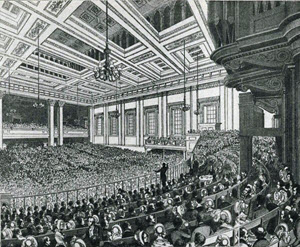
The Corn Laws were tariffs and trade restrictions on imported food and grain ("corn") enforced in Great Britain between 1815 and 1846. They were designed to keep grain prices high to favour domestic producers and imposed steep import duties, making it too expensive to import grain from abroad, even when food supplies were short.
The laws became the focus of opposition from urban groups who had far less political power than rural Britain. The Irish famine of 1845–1852 forced a resolution because of the urgent need for new food supplies. Prime Minister Sir Robert Peel, a Conservative, achieved repeal with the support of the Whigs in Parliament, overcoming the opposition of most of his own party.
- 17 Jun 1815—5 Dec 1815: Second Barbary War

The Second Barbary War (1815) was fought between the United States and the North African Barbary Coast states of Tripoli, Tunis, and Ottoman Algeria. The war ended when the United States Senate ratified Commodore Stephen Decatur’s Algerian treaty on December 5, 1815. However, Dey Omar Agha of Algeria repudiated the US treaty, refused to accept the terms of peace that had been ratified by the Congress of Vienna, and threatened the lives of all Christian inhabitants of Algiers. William Shaler was the US commissioner in Algiers who had negotiated alongside Decatur, but he had to flee aboard British vessels and watch rockets and cannon shot fly over his house "like hail" during the Bombardment of Algiers (1816). He negotiated a new treaty in 1816 which was not ratified by the Senate until February 11, 1822 because of an oversight.
- 18 Jun 1815: Battle of Waterloo
The Battle of Waterloo was fought near Waterloo in present-day Belgium. A French army under the command of Emperor Napoleon Bonaparte was defeated by two of the armies of the Seventh Coalition: a British-led Allied army under the command of the Duke of Wellington, and a Prussian army under the command of Gebhard Leberecht von Blücher, Prince of Wahlstatt. The battle marked the end of the Napoleonic Wars
- 10 Dec 1815: Ada Lovelace born

Augusta Ada King, Countess of Lovelace (née Byron) was an English mathematician and writer, known for her work on Charles Babbage's mechanical general-purpose computer, the Analytical Engine. She was the first to recognise that the machine had applications beyond pure calculation, and published the first algorithm intended to be carried out by such a machine. As a result, she is sometimes regarded as the first to recognise the full potential of a "computing machine" and the first computer programmer.
Lovelace was the only legitimate child of the poet Lord Byron and his wife Anne Isabella "Annabella" Milbanke, Lady Wentworth. Ada translated an article by Italian military engineer Luigi Menabrea, on the Babbage engine, supplementing it with a set of notes, which contain what many consider to be the first computer program, an algorithm designed to be carried out on the engine, if it had ever been built.
|
| 8 | 1817 | - 4 Mar 1817—4 Mar 1825: James Monroe - 5th US President

James Monroe (April 28, 1758 – July 4, 1831) was an American statesman and Founding Father who served as the fifth president of the United States from 1817 to 1825. He is perhaps best known for his foreign policy principle, known as the "Monroe Doctrine", which disallowed further European colonization of the Americas (beginning in 1823).
he sought to ease partisan tensions, embarking on a tour of the country that was well received. Monroe sought to appease the antagonisms and bridge the divisions that had marked American political life since the War of 1812, quietly using his influence as president to encourage compromises and endorsing a consensual form of American patriotism. This method of leadership led historian William E. Weeks to name him the first American "hidden hand president" in reference to Eisenhower's similar practices
|
| 9 | 1818 | - 24 Dec 1818: James Joule born

James Prescott Joule (24 December 1818 – 11 October 1889) was an English physicist, mathematician and brewer, born in Salford, Lancashire. Joule studied the nature of heat, and discovered its relationship to mechanical work. This led to the law of conservation of energy, which in turn led to the development of the first law of thermodynamics. The SI derived unit of energy, the joule, is named after him.
Joule worked with Lord Kelvin to develop an absolute thermodynamic temperature scale, which came to be called the Kelvin scale. Joule also made observations of magnetostriction, and he found the relationship between the current through a resistor and the heat dissipated, which is also called Joule's first law. His experiments about energy transformations were first published in 1843.
|
| 10 | 1820 | - 29 Jan 1820—26 Jun 1830: King George IV's reign

George IV was King of the United Kingdom of Great Britain and Ireland and King of Hanover following the death of his father, King George III, on 29 January 1820, until his own death ten years later. From 1811 until his accession, he served as Prince Regent during his father's final mental illness.
George IV led an extravagant lifestyle that contributed to the fashions of the Regency era. He was a patron of new forms of leisure, style and taste. He commissioned John Nash to build the Royal Pavilion in Brighton and remodel Buckingham Palace, and Sir Jeffry Wyattville to rebuild Windsor Castle.
His charm and culture earned him the title "the first gentleman of England", but his dissolute way of life and poor relationships with his parents and his wife earned him the contempt of the people and dimmed the prestige of the monarchy.
- 12 May 1820: Florence Nightingale born

Florence Nightingale, (12 May 1820 – 13 August 1910) was an English social reformer and statistician, and the founder of modern nursing.
Nightingale came to prominence while serving as a manager and trainer of nurses during the Crimean War, in which she organised care for wounded soldiers. She gave nursing a favourable reputation and became an icon of Victorian culture, especially in the persona of "The Lady with the Lamp" making rounds of wounded soldiers at night. In 1860, Nightingale laid the foundation of professional nursing with the establishment of her nursing school at St Thomas' Hospital in London.
|
| 11 | 1822 | - 27 Dec 1822: Louis Pasteur born

Louis Pasteur (December 27, 1822 – September 28, 1895) was a French biologist, microbiologist and chemist renowned for his discoveries of the principles of vaccination, microbial fermentation and pasteurization. His discoveries have saved many lives. He reduced mortality from puerperal fever, and created the first vaccines for rabies and anthrax. His medical discoveries provided direct support for the germ theory of disease and its application in clinical medicine. He is best known to the general public for his invention of the technique of treating milk and wine to stop bacterial contamination, a process now called pasteurization.
|
| 12 | 1824 | - 26 Jun 1824: Sir William Thomson Lord Kelvin born

William Thomson, 1st Baron Kelvin, (26 June 1824 – 17 December 1907) was a Scots-Irish mathematical physicist and engineer who was born in Belfast. At the University of Glasgow he did important work in the mathematical analysis of electricity and formulation of the first and second laws of thermodynamics, and did much to unify the emerging discipline of physics in its modern form. He also had a career as an electric telegraph engineer and inventor, which propelled him into the public eye and ensured his wealth, fame and honour. He had extensive maritime interests and was most noted for his work on the mariner's compass, which previously had limited reliability.
Absolute temperatures are stated in units of kelvin in his honour.
|
| 13 | 1825 | - 4 Mar 1825—4 Mar 1829: John Quincy Adams - 6th US President

John Quincy Adams (July 11, 1767 – February 23, 1848) was an American statesman who served as the sixth president of the United States from 1825 to 1829.
Adams called for an ambitious agenda that included federally-funded infrastructure projects, the establishment of a national university, and engagement with the countries of Latin America, but many of his initiatives were defeated in Congress. During his presidency, the Democratic-Republic Party polarized into two major camps: the National Republican Party, supported President Adams, and the Democratic Party, led by Andrew Jackson. The Democrats proved to be more effective political organizers and Jackson decisively defeated Adams in the 1828 presidential election
- 27 Sep 1825: Stockton and Darlington railway - World's First

The Stockton and Darlington Railway (S&DR) was a railway company that operated in north-east England from 1825 to 1863. The world's first public railway to use steam locomotives, its first line connected collieries near Shildon with Stockton-on-Tees and Darlington, and was officially opened on 27 September 1825. The movement of coal to ships rapidly became a lucrative business, and the line was soon extended to a new port and town at Middlesbrough. While coal wagons were hauled by steam locomotives from the start, passengers were carried in coaches drawn by horses until carriages hauled by steam locomotives were introduced in 1833.
|
| 14 | 1827 | - 5 Apr 1827: Joseph Lister born

Joseph Lister, 1st Baron Lister, (5 April 1827 – 10 February 1912), was a British surgeon and a pioneer of antiseptic surgery. He promoted the idea of sterile surgery while working at the Glasgow Royal Infirmary. Lister successfully introduced carbolic acid (now known as phenol) to sterilise surgical instruments and to clean wounds.
Applying Louis Pasteur's advances in microbiology, Lister championed the use of carbolic acid as an antiseptic, so that it became the first widely used antiseptic in surgery. He first suspected it would prove an adequate disinfectant because it was used to ease the stench from fields irrigated with sewage waste.
Lister's work led to a reduction in post-operative infections and made surgery safer for patients, distinguishing him as the "father of modern surgery".
- 12 Apr 1827—8 Aug 1827: George Canning - 23rd British Prime Minister

George Canning (11 April 1770 – 8 August 1827) was a British Tory statesman who served as Prime Minister of the United Kingdom from April to August 1827. He occupied various senior cabinet positions under numerous prime ministers, before eventually serving himself as Prime Minister for the final four months of his life.
He died after a mere 119 days in office which, to this day, remains the shortest tenure of any British Prime Minister.
- 31 Aug 1827—8 Jan 1828: Viscount Goderich - 24th British Prime Minister

Frederick John Robinson, 1st Earl of Ripon, (1 November 1782 – 28 January 1859), known as The Viscount Goderich between 1827 and 1833, the name by which he is best known to history, was a British politician during the Regency era. He was Prime Minister of the United Kingdom between August 1827 and January 1828.
When the Prime Minister, George Canning, died in 1827 Goderich succeeded him, but was unable to hold together Canning's fragile coalition of moderate Tories and Whigs. He resigned after 144 days in office, the shortest in history for any British prime minister who did not die in office.
|
| 15 | 1828 | - 22 Jan 1828—16 Nov 1830: Duke of Wellington - 25th British Prime Minister

Arthur Wellesley, 1st Duke of Wellington, (1 May 1769 – 14 September 1852) was an Anglo-Irish soldier and Tory statesman who was one of the leading military and political figures of 19th-century Britain, serving twice as Prime Minister. His victory against Napoleon at the Battle of Waterloo in 1815 puts him in the first rank of Britain's military heroes.
His term as PM was marked by Catholic emancipation: the granting of almost full civil rights to Catholics in Great Britain and Ireland. The change was prompted by the landslide by-election win of Daniel O'Connell, an Irish Catholic proponent of emancipation, who was elected despite not being legally allowed to sit in Parliament. In the House of Lords, facing stiff opposition, Wellington spoke for Catholic Emancipation, and according to some sources, gave one of the best speeches of his career.
|
| 16 | 1829 | - 4 Mar 1829—4 Mar 1837: Andrew Jackson - 7th US President

Andrew Jackson (March 15, 1767 – June 8, 1845) was an American military hero and statesman who served as the seventh president of the United States from 1829 to 1837. As president, Jackson sought to advance the rights of the "common man" against a "corrupt aristocracy" and to preserve the Union.
Jackson faced the threat of secession by South Carolina over the "Tariff of Abominations." The crisis was defused when the tariff was amended, and Jackson threatened the use of military force if South Carolina attempted to secede. In 1835, Jackson became the only president to completely pay off the national debt. In 1830, Jackson signed the Indian Removal Act, which forcibly relocated most members of the Native American tribes in the South to Indian Territory. His administration concluded a "most favored nation" treaty with Great Britain, settled claims of damages against France from the Napoleonic Wars, and recognized the Republic of Texas. In January 1835, he survived the first assassination attempt on a sitting president.
- 30 Nov 1829: Welland Canal Opened

Two schooners passed from Port Dalhousie to Port Robinson, Upper Canada, symbolically opening the Welland Canal and linking Lakes Erie and Ontario for the first time. The canal opened the way to the west and countered the threat of the US Erie Canal.
Text and image © The Canadian Encyclopedia
Photo Credit: Corel Professional Photos
|
| 17 | 1830 | - 26 Jun 1830—20 Jun 1837: King William IV's reign

William IV was King of the United Kingdom of Great Britain and Ireland from 26 June 1830 until his death in 1837. The third son of George III, William succeeded his elder brother George IV, becoming the last king and penultimate monarch of Britain's House of Hanover.
William served in the Royal Navy in his youth and was nicknamed the "Sailor King". In 1789, he was created Duke of Clarence and St Andrews. In 1827, he was appointed as Britain's first Lord High Admiral since 1709. As his two older brothers died without leaving legitimate issue, he inherited the throne when he was 64 years old. His reign saw several reforms: the poor law was updated, child labour restricted, slavery abolished in nearly all of the British Empire, and the British electoral system refashioned by the Reform Act 1832. He was the last monarch to appoint a prime minister contrary to the will of Parliament.
At the time of his death William had no surviving legitimate children. He was succeeded by his niece Victoria and in Hanover by his brother Ernest Augustus.
- 22 Nov 1830—9 Jul 1834: Earl Grey - 26th British Prime Minister

Charles Grey, 2nd Earl Grey, (13 March 1764 – 17 July 1845), known as Viscount Howick between 1806 and 1807, was a member of the Whig Party and was a long-time leader of multiple reform movements, most famously the Reform Act 1832. His government also saw the abolition of slavery in the British Empire, in which the government purchased slaves from their owners in 1833. Grey was a strong opponent of the foreign and domestic policies of William Pitt the Younger in the 1790s. In 1807, he resigned as foreign secretary to protest the King's uncompromising rejection of Catholic Emancipation. Grey finally resigned in 1834 over disagreements in his cabinet regarding Ireland, and retired from politics.
Earl Grey tea is named after him.
|
| 18 | 1831 | - 1831: James Clerk Maxwell born

James Clerk Maxwell (13 June 1831 – 5 November 1879) was a Scottish scientist in the field of mathematical physics. His most notable achievement was to formulate the classical theory of electromagnetic radiation, bringing together for the first time electricity, magnetism, and light as different manifestations of the same phenomenon. Maxwell's equations for electromagnetism have been called the "second great unification in physics" after the first one realised by Isaac Newton.
His discoveries helped usher in the era of modern physics, laying the foundation for such fields as special relativity and quantum mechanics. Many physicists regard Maxwell as the 19th C scientist having the greatest influence on 20th C physics. On the centenary of Maxwell's birthday, Einstein described Maxwell's work as the "most profound and the most fruitful that physics has experienced since the time of Newton".
|
| 19 | 1832 | - 1 Jan 1832: Cholera Epidemic Spreads

Grosse Île, near Québec, was opened as a quarantine station during the cholera epidemics and all ships stopped there for inspection. This station was a futile attempt by the government to control the disease that killed up to 10% of the population.
Text and image © The Canadian Encyclopedia
- 6 Apr 1832—27 Aug 1832: Black Hawk War

The Black Hawk War was a brief conflict between the United States and Native Americans led by Black Hawk, a Sauk leader. The war erupted soon after Black Hawk and a group of Sauks, Meskwakis, and Kickapoos, known as the "British Band", crossed the Mississippi River, into the U.S. state of Illinois, from Iowa Indian Territory in April 1832. Black Hawk's motives were ambiguous, but he was apparently hoping to avoid bloodshed while resettling on tribal land that had been ceded to the United States in the disputed 1804 Treaty of St. Louis.
The war gave the young captain Abraham Lincoln his brief military service, although he never participated in a battle. Other participants who later became famous included Winfield Scott, Zachary Taylor, and Jefferson Davis. The war gave impetus to the U.S. policy of Indian removal, in which Native American tribes were pressured to sell their lands and move west of the Mississippi River and stay there.
|
| 20 | 1833 | - 1833: Slavery Abolition Act

The Slavery Abolition Act abolished slavery in the British Empire. This Act expanded the jurisdiction of the Slave Trade Act 1807 which made the purchase or ownership of slaves illegal within the British Empire, with the exception "of the Territories in the Possession of the East India Co", Ceylon (Sri Lanka), & Saint Helena. The Act was repealed in 1997 as part of a review of English statute but later anti-slavery legislation remains
|
| 21 | 1834 | - 1834: New Poor Law reforms Britain's social security system

In 1832, a Royal Commission into the Poor Law recommended changes to the system of parish poor relief. Many of its recommendations were incorporated into the Poor Law Amendment Act of 1834.
This statute maintained outdoor relief (relief given outside a workhouse), but led to more central control of the system
- 1834: The Workhouse

The Workhouse originated in the Poor Law Act 1388 but mass unemployment after the Napoleonic Wars, & the introduction of technology to replace agricultural workers meant the established system was unsustainable. The Poor Law of 1834 discouraged the provision of relief to anyone who refused to enter a workhouse. Life in a workhouse was harsh but in the provision of free medical care & education for children inmates were advantaged over the general population
- 16 Jul 1834—14 Nov 1834: Viscount Melbourne - 27th British Prime Minister

William Lamb, 2nd Viscount Melbourne, (15 March 1779 – 24 November 1848) was a British Whig statesman who served as Home Secretary (1830–1834) and Prime Minister (1834 and 1835–1841). He is best known for his intense and successful mentoring of Queen Victoria in the ways of politics, when she was between the ages of 18 and 21. Historians have concluded that Melbourne does not rank highly as a Prime Minister, for there were no great foreign wars or domestic issues to handle, he lacked major achievements, and he enunciated no grand principles. "But he was kind, honest and not self-seeking."
Melbourne was Prime Minister on two occasions. The first ended when he was dismissed by King William IV in 1834, the last British prime minister to be dismissed by a monarch. Six months later he was re-appointed and served for six years.
- 17 Nov 1834—9 Dec 1834: Duke of Wellington - 28th British Prime Minister
Arthur Wellesley, 1st Duke of Wellington, (1 May 1769 – 14 September 1852) was an Anglo-Irish soldier and Tory statesman who was one of the leading military and political figures of 19th-century Britain, serving twice as Prime Minister. His victory against Napoleon at the Battle of Waterloo in 1815 puts him in the first rank of Britain's military heroes.
This, his second term as PM, was a caretaker role until a new leader was found.
- 10 Dec 1834—8 Apr 1835: Robert Peel - 29th British Prime Minister

Sir Robert Peel, 2nd Baronet, (5 February 1788 – 2 July 1850) was a British statesman and Conservative Party politician who served twice as Prime Minister of the United Kingdom (1834–35 and 1841–46) and twice as Home Secretary (1822–27 and 1828–30). He is regarded as the father of modern British policing and as one of the founders of the modern Conservative Party.
His first administration was a minority government, dependent on Whig support and with Peel serving as his own Chancellor of the Exchequer. After only four months, his government collapsed and he served as Leader of the Opposition during the second government of the Viscount Melbourne (1835–1841).
|
| 22 | 1835 | - 18 Apr 1835—30 Aug 1841: Viscount Melbourne - 30th British Prime Minister
William Lamb, 2nd Viscount Melbourne, (15 March 1779 – 24 November 1848) was a British Whig statesman who served as Home Secretary (1830–1834) and Prime Minister (1834 and 1835–1841). He is best known for his intense and successful mentoring of Queen Victoria in the ways of politics, when she was between the ages of 18 and 21. Historians have concluded that Melbourne does not rank highly as a Prime Minister, for there were no great foreign wars or domestic issues to handle, he lacked major achievements, and he enunciated no grand principles. "But he was kind, honest and not self-seeking."
Melbourne was Prime Minister on two occasions. The first ended when he was dismissed by King William IV in 1834, the last British prime minister to be dismissed by a monarch. Six months later he was re-appointed and served for six years.
- 2 Oct 1835—21 Apr 1836: Texas War for Independence

The Texas Revolution was a rebellion of colonists from the United States and Tejanos (Texas Mexicans) in putting up armed resistance to the centralist government of Mexico.
While the uprising was part of a larger one that included other provinces opposed to the regime of President Antonio López de Santa Anna, the Mexican government believed the United States had instigated the Texas insurrection with the goal of annexation. The Mexican Congress passed the Tornel Decree, declaring that any foreigners fighting against Mexican troops "will be deemed pirates and dealt with as such, being citizens of no nation presently at war with the Republic and fighting under no recognized flag." Only the province of Texas succeeded in breaking with Mexico, establishing the Republic of Texas, and eventually being annexed by the United States.
The annexation of Texas as the 28th state of the United States, in 1845, led directly to the Mexican–American War.
|
| 23 | 1836 | - 21 Jul 1836: First Railway Opens in Canada

Canada's first railway, the Champlain and St Lawrence Railroad, officially opened; it began operations on July 25. The railway heralded the most important change in transportation in Canadian history.
Text and image © The Canadian Encyclopedia
|
| 24 | 1837 | - 4 Mar 1837—4 Mar 1841: Martin Van Buren - 8th US President

Martin Van Buren (December 5, 1782 – July 24, 1862) was the eighth president of the United States from 1837 to 1841. A founder of the Democratic Party, he previously served as the ninth governor of New York, the tenth U.S. secretary of state, and the eighth vice president of the United States. He won the 1836 presidential election with the endorsement of popular outgoing President Andrew Jackson and the organizational strength of the Democratic Party.
The president proposed the establishment of an independent US treasury, which he contended would take the politics out of the nation's money supply. Under the plan, the government would hold all of its money balances in the form of gold or silver, and would be restricted from printing paper money at will; both measures were designed to prevent inflation. The plan would permanently separate the government from private banks by storing government funds in government vaults rather than in private banks
- 20 Jun 1837—22 Jan 1901: Queen Victoria's reign

Victoria was Queen of the United Kingdom of Great Britain and Ireland from 20 June 1837 until her death. On 1 May 1876, she adopted the additional title of Empress of India.
Victoria inherited the throne at the age of 18, after her father's three elder brothers had all died leaving no surviving legitimate children. She became a national icon who was identified with strict standards of personal morality. Victoria married her first cousin Prince Albert. After his death in 1861, Victoria plunged into deep mourning and avoided public appearances. As a result, republicanism temporarily gained strength but in the latter half of her reign, her popularity recovered. Her Golden and Diamond Jubilees were times of public celebration.
- 1 Jul 1837: Registration of BMDs begins

Before 1837, there was no national system of civil registration in England and Wales. Baptisms, marriages and burials were recorded in parish registers maintained by Church of England clergy. With the increase in nonconformity baptisms, marriages and burials were going unrecorded. The Parochial Registers Act of 1812 did not recognise the church registers of Nonconformists. Eventually, this led to the 1836 Registration and Marriage Acts
- 16 Nov 1837: Insurrection in Lower Canada

Governor Gosford issued warrants for the arrest of 26 Patriote leaders on charges of high treason, initiating the events of the Lower Canada Rebellion. Troops and Patriotes were in battle a few days later.
Text and image © The Canadian Encyclopedia
- 5 Dec 1837: Rebellion in Upper Canada

William Lyon Mackenzie led a rag-tag contingent of 800 men down Yonge Street toward Toronto. Government loyalists dispersed the rebels with a few shots, ending Mackenzie's erratic attempt to overthrow the colonial government.
Text and image © The Canadian Encyclopedia
|
| 25 | 1840 | - 1840: Houses of Parliament

More correctly known as the Palace of Westminster, the Houses of Parliament are the meeting places of the Houses of Commons and Lords. The name is from the neighbouring Westminster Abbey.While the present buildings make look as though they date from the Gothic Period of the 14th and 15th Centuries, they were built between 1840 and 1870 following the 1834 fire
- 1840: British Migration to New Zealand begins

British Migration to New Zealand: In early 19th C, Britain conditions were such that millions set off for the New World. By 1839 there were only 2,000 immigrants in New Zealand, by 1852, 28,000. The decisive moment for this change was 1840 when the Treaty of Waitangi was signed. This established British authority in European eyes, and gave British immigrants legal rights as citizens. The treaty helped ensure that for 100+ years, most immigrants would come from the UK
|
| 26 | 1841 | - 4 Feb 1841—4 Apr 1841: William Henry Harrison - 9th US President

William Henry Harrison Sr. (February 9, 1773 – April 4, 1841) was an American military officer, politician, and the ninth president of the United States. He died of pneumonia thirty-one days into his term, thereby serving the shortest tenure in United States presidential history. Because he was the first president to die in office, his death sparked a constitutional crisis and questions and debates about the presidential line of succession.
He took the oath of office on Thursday, March 4, 1841, a cold and wet day. He wore neither an overcoat nor hat, rode on horseback to the ceremony rather than in the closed carriage that had been offered him, and delivered the longest inaugural address in American history, at 8,445 words
- 4 Apr 1841—4 Mar 1845: John Tyler - 10th US President

John Tyler (March 29, 1790 – January 18, 1862) was the tenth president of the United States from 1841 to 1845 after briefly being the tenth vice president (1841); he was elected to the latter office on the 1840 Whig ticket with President William Henry Harrison.
Tyler ascended to the presidency after Harrison's death in April 1841, only a month after the start of the new administration. He was a supporter of states' rights, and as president he adopted nationalist policies only when they did not infringe on the powers of the states.
- 30 Aug 1841—29 Jun 1846: Robert Peel - 31st British Prime Minister
Sir Robert Peel, 2nd Baronet, (5 February 1788 – 2 July 1850) was a British statesman and Conservative Party politician who served twice as Prime Minister of the United Kingdom (1834–35 and 1841–46) and twice as Home Secretary (1822–27 and 1828–30). He is regarded as the father of modern British policing and as one of the founders of the modern Conservative Party.
His second government ruled for five years. He cut tariffs to stimulate trade; to replace the lost revenue he pushed through a 3% income tax. He played a central role in making free trade a reality and set up a modern banking system.
|
| 27 | 1842 | - 1842: Income Tax
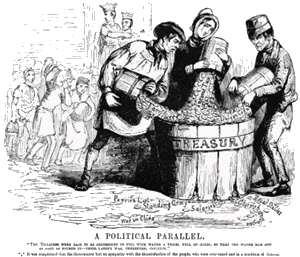
Following the end of the Napoleonic War in 1815, the public mood of compliance with income tax rapidly evaporated. The government wanted to retain it to help reduce the National Debthowever, strong public opposition to the tax was demonstrated by landowners, merchants, manufacturers, bankers, and tradesmen. On 18 March 1816, the government was narrowly defeated on the issue and was forced to abandon it.
By the early 1840s business opinion had moved towards 'free trade' and the removal of high protective duties on imports and exports. Sir Robert Peel, the Prime Minister, was keen to facilitate this thinking. In 1842, therefore, he re-introduced income tax at 7d in the pound on incomes over £150. This allowed him to remove import and export duties on more than 700 items.
- 1842: First Chemical Fertiliser

Sir John Bennet Lawes, 1st Baronet, FRS (28 December 1814 – 31 August 1900) was an English entrepreneur and agricultural scientist. He founded an experimental farm at his home at Rothamsted Manor that eventually became the Rothamsted Experimental Station, where he developed and, in 1842, patented a superphosphate that would mark the beginnings of the chemical fertilizer industry
|
| 28 | 1843 | - 1843: SS Great Britain Launched
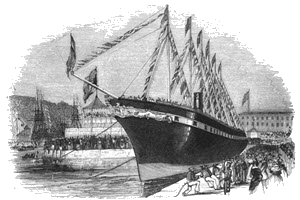
SS Great Britain is a museum ship and former passenger steamship, and was advanced for her time. She was the longest passenger ship in the world from 1845 to 1854. She was designed by Isambard Kingdom Brunel (1806–1859), for the Great Western Steamship Company's transatlantic service between Bristol and New York. While other ships had been built of iron or equipped with a screw propeller, the Great Britain was the first to combine these features in a large ocean-going ship. She was the first iron steamer to cross the Atlantic, which she did in 1845, in 14 days.
|
| 29 | 1845 | - 4 Mar 1845—4 Mar 1849: James K Polk - 11th US President

James Knox Polk (November 2, 1795 – June 15, 1849) was the 11th president of the United States (1845–1849). A protégé of Andrew Jackson, he was a member of the Democratic Party and an advocate of Jacksonian democracy.
During Polk's presidency, the United States expanded significantly with the annexation of the Republic of Texas, the Oregon Territory, and the Mexican Cession following the American victory in the Mexican–American War.
|
| 30 | 1846 | - 25 Apr 1846—3 Feb 1848: Mexican–American War

The Mexican–American War, was an armed conflict between the United States of America and Mexico. It followed the 1845 American annexation of the independent Republic of Texas. The unstable Mexican caudillo leadership of President/General Antonio López de Santa Anna still considered Texas to be its northeastern province and never recognized the Republic of Texas, which had seceded a decade earlier. In 1845, newly elected U.S. President James K. Polk sent troops to the disputed area and a diplomatic mission to Mexico. After Mexican forces attacked American forces, Polk cited this in his request that Congress declare war.
The 1848 Treaty of Guadalupe Hidalgo, ended the war and enforced the Mexican Cession of the northern territories of Alta California and Santa Fe de Nuevo México to the United States. The U.S. agreed to pay $15 million compensation for the physical damage of the war and assumed $3.25 million of debt already owed earlier by the Mexican government to U.S. citizens. Mexico acknowledged the loss of what became the State of Texas and accepted the Rio Grande as its northern border with the U.S.
- 15 Jun 1846: Oregon Boundary Treaty

The Oregon Boundary Treaty was signed, establishing the boundary between British North America and the US at 49° north latitude, leaving Vancouver Island in British hands, and creating a settlement with which Canada and the US could live in harmony.
Text © The Canadian Encyclopedia
- 30 Jun 1846—21 Feb 1852: John Russell - 32nd British Prime Minister

John Russell, 1st Earl Russell, (18 August 1792 – 28 May 1878), known by his courtesy title Lord John Russell before 1861, was a leading Whig and Liberal politician who served as Prime Minister of the United Kingdom on two occasions during the early Victorian era.
He headed a government that failed to deal with the Irish Potato Famine, a disaster which saw the loss of a quarter of that country's population. It has been said that his ministry of 1846 to 1852 was the ruin of the Whig party: it never composed a Government again, and his ministry of 1865 to 1866 was very nearly the ruin of the Liberal Party also.
- 22 Oct 1846: First Telegraph in Canada

The Toronto, Hamilton, Niagara and St Catharines Telegraph Company was established, the first telegraph company in Canada. The first section was opened for use 19 Dec 1846 from Toronto to Hamilton. The telegraph profoundly altered 19th century life.
Text and image © The Canadian Encyclopedia
|
| 31 | 1847 | - 1847: Alexander Graham Bell born

Alexander Graham Bell was a Scottish-born scientist, inventor, engineer, and innovator who is credited with inventing and patenting the first practical telephone. He also founded the American Telephone and Telegraph Company (AT&T) in 1885.
Bell's father, grandfather, and brother had all been associated with work on elocution and speech and both his mother and wife were deaf, profoundly influencing Bell's life's work. His research on hearing and speech further led him to experiment with hearing devices which eventually culminated in Bell being awarded the first U.S. patent for the telephone in 1876. Bell considered his invention an intrusion on his real work as a scientist and refused to have a telephone in his study
|
| 32 | 1848 | - 2 Feb 1848: Responsible Government in Nova Scotia

James Boyle Uniake became leader of a new Reform government. Nova Scotia was thus the first colony in the British Empire in which responsible government was in effect. Responsible government meant that a colony enjoyed complete self-government in domestic affairs and that a government ruled only with the support of the majority of the elected Assembly (the origins of today's cabinet government).
The Nova Scotian patriot par excellence, Howe (pictured) could use his oratorical powers to influence his compatriots as no other man has ever done (courtesy Library and Archives Canada/C-22002).
Text and image © The Canadian Encyclopedia
|
| 33 | 1849 | - 4 Mar 1849—9 Jul 1850: Zachary Taylor - 12th US President

Zachary Taylor (November 24, 1784 – July 9, 1850) was the 12th president of the United States, serving from March 1849 until his death in July 1850.
Taylor previously was a career officer in the United States Army, rose to the rank of major general and became a national hero as a result of his victories in the Mexican–American War. As a result, he won election to the White House despite his vague political beliefs. His top priority as president was preserving the Union, but he died sixteen months into his term, before making any progress on the status of slavery, which had been inflaming tensions in Congress.
|
| 34 | 1850 | - 9 Jul 1850—4 Mar 1853: Millard Fillmore 13th US President

Millard Fillmore (January 7, 1800 – March 8, 1874) was the 13th president of the United States (1850–1853), the last to be a member of the Whig Party while in the White House.
A former U.S. Representative from New York, Fillmore was elected the nation's 12th vice president in 1848, and was elevated to the presidency by the death of Zachary Taylor. He was instrumental in getting the Compromise of 1850 passed, a bargain that led to a brief truce in the battle over slavery. He failed to win the Whig nomination for president in 1852; he gained the endorsement of the nativist Know Nothing Party four years later, and finished third in that election.
|
| 35 | 1851 | - 1851: The Great Exhibition

The Great Exhibition of the Works of Industry of All Nations or The Great Exhibition, sometimes referred to as the Crystal Palace Exhibition in reference to the temporary structure in which it was held, was an international exhibition that took place in Hyde Park, London, from 1 May to 15 October 1851. It was the first in a series of World's Fairs, exhibitions of culture and industry that became popular in the 19th century, and it was a much anticipated event. It was organized by Henry Cole and Prince Albert, husband of the reigning monarch, Queen Victoria. It was attended by famous people of the time,
|
| 36 | 1852 | - 23 Feb 1852—17 Dec 1852: Earl of Derby - 33rd British Prime Minister

Edward George Geoffrey Smith-Stanley, 14th Earl of Derby, (29 March 1799 – 23 October 1869) was a British statesman, three-time Prime Minister of the United Kingdom and, to date, the longest-serving leader of the Conservative Party. He was known before 1834 as Edward Stanley, and from 1834 to 1851 as Lord Stanley. He is one of only four British prime ministers to have three or more separate periods in office. However, his ministries all lasted less than two years and totalled three years and 280 days.
Derby formed a minority government in February 1852 following the collapse of Lord John Russell's Whig Government. When the aged Duke of Wellington, by then very deaf, heard the list of inexperienced cabinet ministers being read aloud in the House of Lords, he gave the government its nickname by shouting "Who? Who?" From then this government would be known as the "Who, Who" government
- 19 Dec 1852—30 Jan 1855: Earl of Aberdeen - 34th British Prime Minister

George Hamilton-Gordon, 4th Earl of Aberdeen, (28 January 1784 – 14 December 1860), was a British statesman, diplomat and landowner, successively a Tory, Conservative and Peelite politician, who served as Prime Minister from 1852 until 1855 in a coalition between the Whigs and Peelites, with Radical and Irish support.
The Aberdeen ministry was filled with powerful and talented politicians, whom Aberdeen was largely unable to control and direct. Despite trying to avoid this happening, it took Britain into the Crimean War, and fell when its conduct became unpopular, after which Aberdeen retired from politics.
|
| 37 | 1853 | - 4 Mar 1853—4 Mar 1857: Franklin Pierce - 14th US President

Franklin Pierce (November 23, 1804 – October 8, 1869) was the 14th president of the United States (1853–1857), a northern Democrat who saw the abolitionist movement as a fundamental threat to the unity of the nation.
He alienated anti-slavery groups by championing and signing the Kansas–Nebraska Act and enforcing the Fugitive Slave Act, yet he failed to stem conflict between North and South, setting the stage for Southern secession and the American Civil War.
|
| 38 | 1854 | - 1854—1856: Crimean War

The Crimean War was fought by an alliance of Britain, France, Turkey and Sardinia against Russian expansion into the Danube region (modern day Romania). One battle - The Battle of Balaclava - became famous for the Charge of the Light Brigade The Crimean war also saw the rise to prominence of Florence Nightingale.
|
| 39 | 1855 | - 6 Feb 1855—19 Feb 1858: Viscount Palmerston - 35th British Prime Minister

Henry John Temple, 3rd Viscount Palmerston, (20 October 1784 – 18 October 1865) was a British statesman who served twice as Prime Minister in the mid-19th century. Palmerston dominated British foreign policy during the period 1830 to 1865, when Britain was at the height of her imperial power. He held office almost continuously from 1807 until his death in 1865. He began his parliamentary career as a Tory, defected to the Whigs in 1830, and became the first Prime Minister of the newly formed Liberal Party in 1859.
He had two periods in office, 1855–1858 and 1859–1865, before his death at the age of 80 years, a few months subsequent to victory in a general election in which he had achieved an increased majority. He remains, to date, the last Prime Minister to die in office.
|
| 40 | 1856 | - 17 Nov 1856: Grand Trunk Completed

The Grand Trunk Railway was completed from Guelph to Stratford, Ontario; the last stretch from St Marys to Sarnia was finished on November 21. The GTR was a significant factor in the economic development of Canada.
Text and image © The Canadian Encyclopedia
|
| 41 | 1857 | - 4 Mar 1857—4 Mar 1861: James Buchanan - 15th US President

James Buchanan Jr. (April 23, 1791 – June 1, 1868) was an American politician who served as the 15th president of the United States (1857–1861), serving immediately prior to the American Civil War.
A member of the Democratic Party, he was the 17th United States secretary of state and had served in the Senate and House of Representatives before becoming president.
|
| 42 | 1858 | - 20 Feb 1858—11 Jun 1859: Earl of Derby - 36th British Prime Minister
Edward George Geoffrey Smith-Stanley, 14th Earl of Derby, (29 March 1799 – 23 October 1869) was a British statesman, three-time Prime Minister of the United Kingdom and, to date, the longest-serving leader of the Conservative Party. He was known before 1834 as Edward Stanley, and from 1834 to 1851 as Lord Stanley. He is one of only four British prime ministers to have three or more separate periods in office. However, his ministries all lasted less than two years and totalled three years and 280 days.
Among the notable achievements of this, his second administration, was the end of the British East India Company following the Sepoy Mutiny, which brought India under direct British control for the first time. Once again the government was short-lived, resigning after only one year, having narrowly lost a vote of no-confidence
- 25 Apr 1858: Fraser River Gold Rush

The first wave of miners from California arrived at Victoria, en route to the Fraser River Gold Rush. The Gold Rush caused a precipitous decline in the Native population and politically unified British Columbia.
Text and image © The Canadian Encyclopedia
|
| 43 | 1859 | - 1859: Sir Arthur Conan Doyle born

Sir Arthur Conan Doyle was Scottish author who created the legendary character, 'Sherlock Holmes.' He wrote over 60 'Sherlock Holmes' stories and many non-fiction, works of fantasy, science-fiction, poetry and historical novels. He went to medical school and set up his own practice. His medical career did not succeed and he began writing while he waited for patients. The rest is history.
- 12 Jun 1859—18 Oct 1865: Viscount Palmerston - 37th British Prime Minister
Henry John Temple, 3rd Viscount Palmerston, (20 October 1784 – 18 October 1865) was a British statesman who served twice as Prime Minister in the mid-19th century. Palmerston dominated British foreign policy during the period 1830 to 1865, when Britain was at the height of her imperial power. He held office almost continuously from 1807 until his death in 1865. He began his parliamentary career as a Tory, defected to the Whigs in 1830, and became the first Prime Minister of the newly formed Liberal Party in 1859.
He had two periods in office, 1855–1858 and 1859–1865, before his death at the age of 80 years, a few months subsequent to victory in a general election in which he had achieved an increased majority. He remains, to date, the last Prime Minister to die in office.
- 24 Nov 1859: On the Origin of Species published

On the Origin of Species (or more completely, On the Origin of Species by Means of Natural Selection, or the Preservation of Favoured Races in the Struggle for Life), published on 24 November 1859, is a work of scientific literature by Charles Darwin which is considered to be the foundation of evolutionary biology. Darwin's book introduced the scientific theory that populations evolve over the course of generations through a process of natural selection. It presented a body of evidence that the diversity of life arose by common descent through a branching pattern of evolution. Darwin included evidence that he had gathered on the Beagle expedition in the 1830s and his subsequent findings from research, correspondence, and experimentation.
|
| 44 | 1861 | - 4 Mar 1861—15 Apr 1865: Abraham Lincoln - 16th US President

Abraham Lincoln (February 12, 1809 – April 15, 1865) was an American lawyer and politician who served as the 16th president of the United States from 1861 until his assassination in April 1865.
Lincoln led the nation through the Civil War, its bloodiest war and its greatest moral, constitutional, and political crisis. In doing so, he preserved the Union, abolished slavery, strengthened the federal government, and modernized the economy.
- 12 Apr 1861—9 May 1865: American Civil War

The American Civil War was fought in the United States from 1861 to 1865. The Civil War is the most studied and written about episode in U.S. history. Primarily as a result of the long-standing controversy over the enslavement of black people, war broke out in April 1861 when secessionist forces attacked Fort Sumter in South Carolina shortly after Abraham Lincoln had been inaugurated as the President of the United States. The loyalists of the Union in the North proclaimed support for the Constitution. They faced secessionists of the Confederate States in the South, who advocated for states' rights to uphold slavery.
The war ended when General Robert E. Lee surrendered to General Ulysses S. Grant at the Battle of Appomattox Court House. Confederate generals throughout the southern states followed suit. Much of the South's infrastructure was destroyed, especially the transportation systems. The Confederacy collapsed, slavery was abolished, and four million black slaves were freed. During the Reconstruction Era that followed the war, national unity was slowly restored, the national government expanded its power, and civil rights were guaranteed to freed black slaves through amendments to the Constitution and federal legislation.
|
| 45 | 1863 | - 1863: First Underground Railways

The history of the London Underground began with the construction of the Metropolitan Railway, the world's first underground railway which opened in 1863 using gas-lit wooden carriages hauled by steam locomotives. The Metropolitan eventually extended more than 50 miles from Baker Street, London. By 1907 the District and Metropolitan Railways had electrified the underground sections of their lines.
|
| 46 | 1864 | - 1 Aug 1864: Charlottetown Conference

The Charlottetown Conference was held in Charlottetown, PEI. At the conference Maritime union was virtually dropped, and the delegates agreed to meet a new conference in Québec to discuss a Canadian scheme for a union of all the colonies.
Text and image © The Canadian Encyclopedia
|
| 47 | 1865 | - 15 Apr 1865—4 Mar 1869: Andrew Johnson - 17th US President

Andrew Johnson (December 29, 1808 – July 31, 1875) was the 17th president of the United States, serving from 1865 to 1869. Johnson assumed the presidency as he was vice president of the United States at the time of the assassination of Abraham Lincoln.
A Democrat who ran with Lincoln on the National Union ticket, Johnson came to office as the Civil War concluded. He favored quick restoration of the seceded states to the Union. His plans did not give protection to the former slaves; he came into conflict with the Republican-dominated Congress, culminating in his impeachment by the House of Representatives. He was acquitted in the Senate by one vote.
- 29 Oct 1865—26 Jun 1866: John Russell - 38th British Prime Minister
John Russell, 1st Earl Russell, (18 August 1792 – 28 May 1878), known by his courtesy title Lord John Russell before 1861, was a leading Whig and Liberal politician who served as Prime Minister of the United Kingdom on two occasions during the early Victorian era.
When Palmerston suddenly died in late 1865, Russell again became Prime Minister. His second premiership was short and frustrating, and Russell failed in his great ambition of expanding the franchise, a task that would be left to his Conservative successors, Derby and Benjamin Disraeli. In 1866, party disunity again brought down his government.
|
| 48 | 1866 | - 28 Jun 1866—25 Feb 1868: Earl of Derby - 39th British Prime Minister
Edward George Geoffrey Smith-Stanley, 14th Earl of Derby, (29 March 1799 – 23 October 1869) was a British statesman, three-time Prime Minister of the United Kingdom and, to date, the longest-serving leader of the Conservative Party. He was known before 1834 as Edward Stanley, and from 1834 to 1851 as Lord Stanley. He is one of only four British prime ministers to have three or more separate periods in office. However, his ministries all lasted less than two years and totalled three years and 280 days.
Derby returned to power for the third and last time in 1866. This administration was particularly notable for the passage of the Reform Act 1867, which greatly expanded the suffrage but which provoked the resignation of three cabinet ministers including the Secretary for India and three-time future Prime Minister, Lord Cranborne (later Lord Salisbury).
|
| 49 | 1867 | - 8 Mar 1867: British North America Act

The British North America Act was passed by the British Parliament and given royal assent by Queen Victoria on 29 March. It came into effect on 1 July. The Act joined the colonies of Canada, Nova Scotia and New Brunswick in one federal union.
Text and image © The Canadian Encyclopedia
- 1 Jul 1867—5 Nov 1873: Sir John A. Macdonald - 1st Canadian Prime Minister

Sir John Alexander Macdonald (11 January 1815 – 6 June 1891) was the first prime minister of Canada (1867–1873, 1878–1891). The dominant figure of Canadian Confederation, he had a political career which spanned almost half a century. Macdonald was born in Scotland; when he was a boy his family immigrated to Kingston in the Province of Upper Canada (today in eastern Ontario).
In 1864, when no party proved capable of governing for long, Macdonald agreed to a proposal from his political rival, George Brown, that the parties unite in a Great Coalition to seek federation and political reform. Macdonald was the leading figure in the subsequent discussions and conferences, which resulted in the British North America Act and the birth of Canada as a nation on 1 July 1867. Macdonald was the first Prime Minister of the new nation, and served 19 years; only William Lyon Mackenzie King served longer.
- 7 Nov 1867: Marie Curie Born

Marie Skłodowska Curie; born Maria Salomea Skłodowska 7 November 1867 – 4 July 1934) was a Polish and naturalized-French physicist and chemist who conducted pioneering research on radioactivity. She was the first woman to win a Nobel Prize, the first person and only woman to win twice, and the only person to win a Nobel Prize in two different sciences. She was part of the Curie family legacy of five Nobel Prizes. She was also the first woman to become a professor at the University of Paris, and in 1995 became the first woman to be entombed on her own merits in the Panthéon in Paris.
She was born in Warsaw, in what was then the Kingdom of Poland, part of the Russian Empire. She studied at Warsaw's clandestine Flying University and began her practical scientific training in Warsaw. In 1891, aged 24, she followed her older sister Bronisława to study in Paris, where she earned her higher degrees and conducted her subsequent scientific work. She shared the 1903 Nobel Prize in Physics with her husband Pierre Curie and physicist Henri Becquerel. She won the 1911 Nobel Prize in Chemistry.
|
| 50 | 1868 | - 27 Feb 1868—1 Dec 1868: Benjamin Disraeli - 40th British Prime Minister

Benjamin Disraeli, 1st Earl of Beaconsfield, (21 December 1804 – 19 April 1881) was a British statesman who twice served as Prime Minister of the United Kingdom.
During his first term of office, the Conservatives remained a minority in the House of Commons and the passage of the Reform Bill required the calling of a new election once the new voting register had been compiled. Disraeli's term as Prime Minister, which began in February 1868, would therefore be short.
- 3 Dec 1868—17 Feb 1874: William Ewart Gladstone - 41st British Prime Minister

William Ewart Gladstone (29 December 1809 – 19 May 1898) was a British statesman and Liberal Party politician. In a career lasting over sixty years, he served for twelve years as Prime Minister of the United Kingdom, spread over four terms beginning in 1868 and ending in 1894.
Many reforms were passed during his first ministry, including the disestablishment of the Church of Ireland and the introduction of secret voting. After electoral defeat in 1874, Gladstone resigned as leader of the Liberal Party.
|
| 51 | 1869 | - 4 Mar 1869—4 Mar 1877: Ulysses S Grant - 18th US President

Ulysses S Grant (born Hiram Ulysses Grant;[b] April 27, 1822 – July 23, 1885) was the 18th president of the United States from 1869 to 1877, commanding general of the Army, soldier, international statesman, and author.
Elected the youngest 19th Century president in 1868, Grant stabilized the post-war national economy, created the Department of Justice, and prosecuted the Ku Klux Klan. He appointed African-Americans and Jewish-Americans to prominent federal offices. In 1871, Grant created the first Civil Service Commission. The Democrats and Liberal Republicans united behind Grant's opponent in the presidential election of 1872, but Grant was handily re-elected. Grant's new Peace Policy for Native Americans had both successes and failures.
- 2 Nov 1869: Red River Resistance

With 120 men, Louis Riel occupied Fort Garry in the Red River Colony to block the transfer of the Northwest from the Hudson's Bay Company to Canada. The resistance resulted in the formation of the new province of Manitoba but Riel was exiled.
Text and image © The Canadian Encyclopedia
|
| 52 | 1870 | - 1870: Education Act

The 1870 Education Act stands as the very first piece of legislation to deal specifically with the provision of education in Britain. Most importantly, it demonstrated a commitment to provision on a national scale.
The Act allowed voluntary schools to carry on unchanged, but established a system of 'school boards' to build and manage schools in areas where they were needed. The boards were locally elected bodies which drew their funding from the local rates. Unlike the voluntary schools, religious teaching in the board schools was to be 'non-denominational'. A separate Act extended similar provisions to Scotland in 1872.
|
| 53 | 1871 | - 1871: Ernest Rutherford born

Ernest Rutherford was a New Zealand physicist known as the father of nuclear physics.
He received the Nobel Prize in Chemistry in 1908 “for his investigations into the disintegration of the elements & the chemistry of radioactive substances.” He identified & named the Alpha & Beta
- 8 Apr 1871: Treaty of Washington

The Treaty of Washington granted Americans fishing rights in Canadian waters and the use of Canadian canals and the St Lawrence River. Canadians were allowed to navigate Lake Michigan, the St Clair Flats Canal and Alaskan rivers.
Text © The Canadian Encyclopedia<
- 3 Aug 1871: Treaty Number 1

The Numbered Treaties were a series of 11 treaties made between the Crown and Indigenous peoples of Canada from 1871 to 1921. They cover the area between the Lake of the Woods (northern Ontario, southern Manitoba) to the Rocky Mountains (northeastern British Columbia and interior Plains of Alberta) to the Beaufort Sea (north of Yukon and the Northwest Territories).
Treaty No. 1: The first post-Confederation treaty was signed at Lower Fort Garry, Man. The first of many “Numbered Treaties,” Treaty No. 1 was signed between the Crown and the Ojibwa and Swampy Cree Nations. The treaty included the provision of livestock, agricultural equipment and the establishment of schools in exchange for ceding large tracts of Aboriginal hunting grounds.
Text and image © The Canadian Encyclopedia
- 21 Aug 1871: Treaty Number 2

The Numbered Treaties were a series of 11 treaties made between the Crown and Indigenous peoples of Canada from 1871 to 1921. They cover the area between the Lake of the Woods (northern Ontario, southern Manitoba) to the Rocky Mountains (northeastern British Columbia and interior Plains of Alberta) to the Beaufort Sea (north of Yukon and the Northwest Territories).
Treaty No. 2 was concluded with Chippewa of Manitoba, who ceded land from the mouth of Winnipeg River to the northern shores of Lake Manitoba across the Assiniboine River to the United States frontier.
Text and image © The Canadian Encyclopedia
|
| 54 | 1873 | - 3 Oct 1873: Treaty Number 3

The Numbered Treaties were a series of 11 treaties made between the Crown and Indigenous peoples of Canada from 1871 to 1921. They cover the area between the Lake of the Woods (northern Ontario, southern Manitoba) to the Rocky Mountains (northeastern British Columbia and interior Plains of Alberta) to the Beaufort Sea (north of Yukon and the Northwest Territories).
Treaty No. 3 was signed by the Saulteaux (Chippewa) of northwestern Ontario and of Manitoba. For the surrender of a tract comprising about 55,000 sq. miles, the Dominion Government reserved not more than one square mile for each family of five and agreed to pay $12 per head and an annuity of $5 per head.
Text and image © The Canadian Encyclopedia
- 7 Nov 1873—8 Oct 1878: Alexander Mackenzie - 2nd Canadian Prime Minister

Alexander Mackenzie (January 28, 1822 – April 17, 1892), was a Scottish-Canadian politician who served as the second prime minister of Canada, in office from 1873 to 1878. Mackenzie was born in Logierait, Perthshire, Scotland and emigrated to Canada when he was 19, settling in what became Ontario.
In 1867, Mackenzie was elected to the new House of Commons of Canada for the Liberal Party. He became leader of the party (and thus Leader of the Opposition) in mid-1873, and a few months later succeeded John A. Macdonald as prime minister, following Macdonald's resignation in the aftermath of the Pacific Scandal. Mackenzie and the Liberals won a clear majority at the 1874 election.
As prime minister, Mackenzie continued the nation-building programme that had been begun by his predecessor. His government established the Supreme Court of Canada and Royal Military College of Canada, and created the District of Keewatin to better administer Canada's newly acquired western territories. At the 1878 election, Mackenzie's government suffered a landslide defeat.
|
| 55 | 1874 | - 20 Feb 1874—21 Apr 1880: Benjamin Disraeli - 42nd British Prime Minister
Benjamin Disraeli, 1st Earl of Beaconsfield, (21 December 1804 – 19 April 1881) was a British statesman who twice served as Prime Minister of the United Kingdom.
Disraeli's new government enacted many reforms, including:
- the Artisans' and Labourers' Dwellings Improvement Act 1875, which made inexpensive loans available to towns and cities to construct working-class housing.
- the Public Health Act 1875, modernising sanitary codes through the nation,
- the Sale of Food and Drugs Act (1875)
- the Education Act (1876).
- the Factory Act meant to protect workers,
- the Conspiracy, and Protection of Property Act 1875, which allowed peaceful picketing
- the Employers and Workmen Act (1875) to enable workers to sue employers in the civil courts if they broke legal contracts.
As a result of these social reforms the Liberal-Labour MP Alexander Macdonald said, "The Conservative party have done more for the working classes in five years than the Liberals have in fifty."
- 15 Sep 1874: Treaty Number 4
The Numbered Treaties were a series of 11 treaties made between the Crown and Indigenous peoples of Canada from 1871 to 1921. They cover the area between the Lake of the Woods (northern Ontario, southern Manitoba) to the Rocky Mountains (northeastern British Columbia and interior Plains of Alberta) to the Beaufort Sea (north of Yukon and the Northwest Territories).
Treaty No. 4 was signed at Fort Qu'Appelle, Sask, with Cree, Saulteaux (Chippewa) and other First Nations.
Text and image © The Canadian Encyclopedia
|
| 56 | 1875 | - 20 Sep 1875: Treaty Number 5

The Numbered Treaties were a series of 11 treaties made between the Crown and Indigenous peoples of Canada from 1871 to 1921. They cover the area between the Lake of the Woods (northern Ontario, southern Manitoba) to the Rocky Mountains (northeastern British Columbia and interior Plains of Alberta) to the Beaufort Sea (north of Yukon and the Northwest Territories).
Treaty No. 5 was concluded at Lake Winnipeg ceding an area of approximately 100,000 sq. miles inhabited by Chippewa and Swampy Cree (Maskegon) of Manitoba and Ontario.
Text and image © The Canadian Encyclopedia
|
| 57 | 1876 | - 1876: The Telephone is patented

"Mr. Watson — Come here — I want to see you" were the first intelligible words spoken over the telephone, as recorded in Bell's Journal entry (10 March 1876). These are often misquoted as "Mr. Watson, come here, I want you." Watson later recounted that Bell had spilled battery acid and had called for him over the phone with these words, but this may have been in a separate incident.
- 23 Aug 1876: Treaty Number 6
The Numbered Treaties were a series of 11 treaties made between the Crown and Indigenous peoples of Canada from 1871 to 1921. They cover the area between the Lake of the Woods (northern Ontario, southern Manitoba) to the Rocky Mountains (northeastern British Columbia and interior Plains of Alberta) to the Beaufort Sea (north of Yukon and the Northwest Territories).
Treaty No. 6 was signed at Carlton and at Fort Pitt with the Plains Cree, Woodland Cree and Assiniboine. It ceded an area of 120,000 sq. miles of the plains of Saskatchewan and Alberta.
Text and image © The Canadian Encyclopedia
|
| 58 | 1877 | - 4 Mar 1877—4 Feb 1881: Rutherford B Hayes 19th US President

Rutherford Birchard Hayes (October 4, 1822 – January 17, 1893) was the 19th president of the United States from 1877 to 1881, having served also as an American representative and governor of Ohio. Hayes was a lawyer and staunch abolitionist who defended refugee slaves in court proceedings in the antebellum years.
Hayes believed in meritocratic government and equal treatment without regard to race. He ordered federal troops to guard federal buildings and in so doing restore order from the Great Railroad Strike of 1877. He implemented modest civil service reforms that laid the groundwork for further reform in the 1880s and 1890s. He vetoed the Bland–Allison Act, which would have put silver money into circulation.
- 22 Sep 1877: Treaty Number 7

The Numbered Treaties were a series of 11 treaties made between the Crown and Indigenous peoples of Canada from 1871 to 1921. They cover the area between the Lake of the Woods (northern Ontario, southern Manitoba) to the Rocky Mountains (northeastern British Columbia and interior Plains of Alberta) to the Beaufort Sea (north of Yukon and the Northwest Territories).
Treaty No. 7 was signed at Blackfoot Crossing in southern Alberta by the Blackfoot, Blood, Peigan, Sarsi and Stoney. Canadian officials understood that by the treaty First Nations surrendered some 35,000 sq miles of land to the Crown in return for reserves, payments and annuities.
Text and image © The Canadian Encyclopedia
|
| 59 | 1878 | - 17 Sep 1878—6 Jun 1891: Sir John A. Macdonald - (1st) Canadian Prime Minister
Sir John Alexander Macdonald (11 January 1815 – 6 June 1891) was the first prime minister of Canada (1867–1873, 1878–1891). The dominant figure of Canadian Confederation, he had a political career which spanned almost half a century. Macdonald was born in Scotland; when he was a boy his family immigrated to Kingston in the Province of Upper Canada (today in eastern Ontario).
He was re-elected in 1878. Macdonald's greatest achievements were building and guiding a successful national government for the new Dominion, using patronage to forge a strong Conservative Party, promoting the protective tariff of the National Policy, and completing the railway. He fought to block provincial efforts to take power back from the national government in Ottawa. His most controversial move was to approve the execution of Métis leader Louis Riel for treason in 1885; it alienated many francophones from his Conservative Party. He died in 1891, still in office; he is respected today for his key role in the formation of Canada. Historical rankings have consistently placed Macdonald as one of the highest rated Prime Ministers in Canadian history.
|
| 60 | 1879 | - 14 Mar 1879: Albert Einstein born

Albert Einstein (14 March 1879 – 18 April 1955) was a German-born theoretical physicist who developed the theory of relativity, one of the two pillars of modern physics (alongside quantum mechanics). His work is also known for its influence on the philosophy of science.
He is best known to the general public for his mass–energy equivalence formula E = mc2, which has been dubbed "the world's most famous equation". He received the 1921 Nobel Prize in Physics "for his services to theoretical physics, and especially for his discovery of the law of the photoelectric effect", a pivotal step in the development of quantum theory.
|
| 61 | 1880 | - 23 Apr 1880—9 Jun 1885: William Ewart Gladstone - 43rd British Prime Minister
William Ewart Gladstone (29 December 1809 – 19 May 1898) was a British statesman and Liberal Party politician. In a career lasting over sixty years, he served for twelve years as Prime Minister of the United Kingdom, spread over four terms beginning in 1868 and ending in 1894.
Historians have debated the wisdom of Gladstone's foreign-policy during his second ministry. Paul Hayes says it "provides one of the most intriguing and perplexing tales of muddle and incompetence in foreign affairs, unsurpassed in modern political history until the days of Grey and, later, Neville Chamberlain."
- 1 Sep 1880: Arctic Sovereignty

British sovereignty over the Arctic Islands passed to Canada.
Arctic sovereignty is a key part of Canada’s history and future — 40 per cent of the country’s landmass is in its three northern territories, and the country has 162,000 kilometers of Arctic coastline
Text and image © The Canadian Encyclopedia
|
| 62 | 1881 | - 4 Mar 1881—19 Sep 1881: James A. Garfield - 20th US President

James Abram Garfield (November 19, 1831 – September 19, 1881) was the 20th president of the United States, serving from March 4, 1881 until his death by assassination six and a half months later.
Garfield was shot by Charles J. Guiteau, a disgruntled office seeker, at the Baltimore and Potomac Railroad Station in Washington, DC on July 2, 1881. After eleven weeks of intensive and other care Garfield died in Elberon, New Jersey, the second of four presidents to be assassinated, following Abraham Lincoln.
- 6 Aug 1881: Sir Alexander Fleming born

Sir Alexander Fleming (6 August 1881 – 11 March 1955) was a Scottish physician, microbiologist, and pharmacologist. His best-known discoveries are the enzyme lysozyme in 1923 and the world's first antibiotic substance benzylpenicillin (Penicillin G) from the mould Penicillium notatum in 1928, for which he shared the Nobel Prize in Physiology or Medicine in 1945 with Howard Florey and Ernst Boris Chain. He wrote many articles on bacteriology, immunology, and chemotherapy.
- 19 Sep 1881—3 Mar 1885: Chester A Arthur - 21st US President

Chester Alan Arthur (October 5, 1829 – November 18, 1886) was an American attorney and politician who served as the 21st president of the United States from 1881 to 1885; he was the 20th vice president of the United States and became president upon the death (assassination) of President James Garfield in September 1881.
Arthur arrived in Washington, D.C. on September 21. On September 22, he re-took the oath of office, this time before Chief Justice Morrison R. Waite. Arthur took this step to ensure procedural compliance; there had been a lingering question about whether a state court judge (Brady) could administer a federal oath of office. He initially took up residence at the home of Senator John P. Jones, while White House remodeling he ordered was carried out, including the addition of an elaborate fifty-foot glass screen made by Louis Comfort Tiffany, which remained in a White House corridor until it was dismantled in 1902.
|
| 63 | 1884 | - 1884: The Greenwich Prime Meridian

A prime meridian, based at the Royal Observatory, Greenwich, in London was established by Sir George Airy in 1851. By 1884, over two-thirds of all ships and tonnage used it as the reference meridian on their charts and maps. In October of that year, at the behest of US President Chester A. Arthur, 41 delegates from 25 nations met in Washington, D.C., United States, for the International Meridian Conference. This conference selected the meridian passing through Greenwich as the official prime meridian due to its popularity. However, France abstained from the vote, and French maps continued to use the Paris meridian for several decades.
|
| 64 | 1885 | - 4 Mar 1885—4 Mar 1889: Grover Cleveland - 22nd US President

Stephen Grover Cleveland (March 18, 1837 – June 24, 1908) was an American politician and lawyer who was the 22nd and 24th president of the United States, the only president in American history to serve two non-consecutive terms in office (1885–1889 and 1893–1897).
Cleveland was the leader of the pro-business Bourbon Democrats who opposed high tariffs, Free Silver, inflation, imperialism, and subsidies to business, farmers, or veterans on libertarian philosophical grounds.
- 23 Jun 1885—28 Jan 1886: Marquess of Salisbury 44th British Prime Minister

Robert Arthur Talbot Gascoyne-Cecil, 3rd Marquess of Salisbury, (3 February 1830 – 22 August 1903), styled Lord Robert Cecil before 1865 and Viscount Cranborne from June 1865 until April 1868, was a British statesman and Conservative Party politician, serving as Prime Minister three times for a total of over thirteen years. He was the last Prime Minister to head his full administration from the House of Lords.
He became Prime Minister of a minority administration from 1885 to 1886. In the November 1883 issue of National Review Salisbury wrote an article titled "Labourers' and Artisans' Dwellings" in which he argued that the poor conditions of working class housing were injurious to morality and health
- 7 Nov 1885: Last Spike Driven for Canadian Pacific Railway

The last spike was driven by Donald Smith at Craigellachie, BC, at the western entrance to Eagle Pass, in a ceremony marking the completion of the Canadian Pacific Railway. The CPR provided a transportation link from Atlantic to Pacific.
Text and image © The Canadian Encyclopedia
- 16 Nov 1885: Louis Riel Hanged

Louis Riel was hanged for treason at the Regina jail. He had been convicted after a trial held in Regina from 28 July to 1 August. Macdonald's refusal to grant leniency made Riel a symbol of English-Canadian oppression.
Text and image © The Canadian Encyclopedia
|
| 65 | 1886 | - 1 Feb 1886—20 Jul 1886: William Ewart Gladstone - 45th British Prime Minister
William Ewart Gladstone (29 December 1809 – 19 May 1898) was a British statesman and Liberal Party politician. In a career lasting over sixty years, he served for twelve years as Prime Minister of the United Kingdom, spread over four terms beginning in 1868 and ending in 1894.
During this administration he first introduced his Home Rule Bill for Ireland. The issue split the Liberal Party (a breakaway group went on to create the Liberal Unionist party) and the bill was thrown out on the second reading, ending his government after only a few months and inaugurating another headed by Lord Salisbury.
- 25 Jul 1886—11 Aug 1892: Marquess of Salisbury - 46th British Prime Minister
Robert Arthur Talbot Gascoyne-Cecil, 3rd Marquess of Salisbury, (3 February 1830 – 22 August 1903), styled Lord Robert Cecil before 1865 and Viscount Cranborne from June 1865 until April 1868, was a British statesman and Conservative Party politician, serving as Prime Minister three times for a total of over thirteen years. He was the last Prime Minister to head his full administration from the House of Lords.
In 1889 Salisbury set up the London County Council and then in 1890 allowed it to build houses. However, he came to regret this, saying in November 1894 that the LCC, "is the place where collectivist and socialistic experiments are tried. It is the place where a new revolutionary spirit finds its instruments and collects its arms".
|
| 66 | 1888 | - 13 Aug 1888: John Logie Baird born

John Logie Baird (13 August 1888 – 14 June 1946) was a Scottish engineer, innovator, one of the inventors of the mechanical television, demonstrating the first working television system on 26 January 1926, and inventor of both the first publicly demonstrated colour television system, and the first purely electronic colour television picture tube.
In 1928 the Baird Television Development Company achieved the first transatlantic television transmission. Baird's early technological successes and his role in the practical introduction of broadcast television for home entertainment have earned him a prominent place in television's history.
|
| 67 | 1889 | - 4 Mar 1889—4 Mar 1893: Benjamin Harrison - 23rd US President

Benjamin Harrison (August 20, 1833 – March 13, 1901) was an American politician and lawyer who served as the 23rd president of the United States from 1889 to 1893. He was a grandson of the ninth president, William Henry Harrison, creating the only grandfather–grandson duo to have held the office.
Harrison's administration included unprecedented economic legislation, including the McKinley Tariff, which imposed historic protective trade rates, and the Sherman Antitrust Act. Harrison also facilitated the creation of the national forest reserves through an amendment to the Land Revision Act of 1891. During his administration six western states were admitted to the Union.
|
| 68 | 1890 | - 31 Mar 1890: Manitoba School Act

The Manitoba School Act abolished publicly funded support for separate schools for Catholics. The aggrieved French minority argued that the Act violated the agreements under which Manitoba entered Confederation.
Text © The Canadian Encyclopedia
|
| 69 | 1891 | - 16 Jun 1891—24 Nov 1892: Sir John Abbott - 3rd Canadian Prime Minister

Sir John Joseph Caldwell Abbott, (March 12, 1821 – October 30, 1893), was a Canadian lawyer and politician, who served as the third prime minister of Canada, in office from 1891 to 1892. He held office as the leader of the Conservative Party. Abbott was born in what is now Saint-André-d'Argenteuil, Quebec.
In the 1867 federal election, Abbott was elected to the new House of Commons of Canada as a member of the Conservative Party. A telegram leaked from his office played a key part in the Pacific Scandal of 1873, which led to the downfall of John A. Macdonald's first government. Abbott was appointed to the Senate in 1887, in order to become Leader of the Government in the Senate. He became prime minister in June 1891 following Macdonald's death in office. Abbott was 70 years old at the time, and served only until November 1892
- 20 Oct 1891: Sir James Chadwick born

Sir James Chadwick was an English physicist. When his university Professor, Ernest Rutherford became the Director of Research at Cavendish Lab, he invited Chadwick to join him. While there, he discovered the neutron, for which he won the 1935 Nobel Prize in Physics. It led to the development of the atomic bomb. He was distressed that his discovery had been used to kill many innocent people
|
| 70 | 1892 | - 1 Jan 1892: Ellis Island opens

Ellis Island, in Upper New York Bay, was the gateway for over 12 million immigrants to the U.S. as the United States' busiest immigrant inspection station for over 60 years from 1892 until 1954. Ellis Island was opened January 1, 1892. The island was greatly expanded with land reclamation between 1892 and 1934. Before that, the much smaller original island was the site of Fort Gibson and later a naval magazine.
The island was made part of the Statue of Liberty National Monument in 1965 and has hosted a museum of immigration since 1990. "As a visitor to this place, you stand in awe. It has the aura of an ancient cathedral, redolent with the millions who passed through these doors."
- 15 Aug 1892—2 Mar 1894: William Ewart Gladstone - 47th British Prime Minister
William Ewart Gladstone (29 December 1809 – 19 May 1898) was a British statesman and Liberal Party politician. In a career lasting over sixty years, he served for twelve years as Prime Minister of the United Kingdom, spread over four terms beginning in 1868 and ending in 1894.
The general election of 1892 resulted in a minority Liberal government with Gladstone as Prime Minister. The electoral address had promised Irish Home Rule and the disestablishment of the Scottish and Welsh Churches.[118] In February 1893 he introduced the Second Home Rule Bill, which was passed in the Commons at second reading on 21 April by 43 votes and third reading on 1 September by 34 votes. The House of Lords defeated the bill by voting against by 419 votes to 41 on 8 September.
- 5 Dec 1892—12 Dec 1894: Sir John Thompson - 4th Canadian Prime Minister

Sir John Sparrow David Thompson (November 10, 1845 – December 12, 1894) was a Canadian lawyer, judge, and politician who served as the fourth prime minister of Canada, in office from 1892 until his death. He had previously been premier of Nova Scotia for a brief period in 1882. Thompson was born in Halifax, Nova Scotia. .
In 1885, Thompson entered federal politics at the personal request of Sir John A. Macdonald, becoming Minister of Justice. In that role he was the driving force behind the enactment of the Canadian Criminal Code. Thompson became prime minister in 1892, following the retirement of John Abbott. He was the first Roman Catholic to hold the position. On a trip to England in 1894, Thompson unexpectedly suffered a heart attack and died, aged 49
|
| 71 | 1893 | - 4 Mar 1893—4 Mar 1897: Grover Cleveland - 24th US President
Stephen Grover Cleveland (March 18, 1837 – June 24, 1908) was an American politician and lawyer who was the 22nd and 24th president of the United States, the only president in American history to serve two non-consecutive terms in office (1885–1889 and 1893–1897).
As his second administration began, disaster hit the nation when the Panic of 1893 produced a severe national depression, which Cleveland was unable to reverse. It ruined his Democratic Party, opening the way for a Republican landslide in 1894
|
| 72 | 1894 | - 1894: Tower Bridge - London's Defining Landmark

London’s iconic Tower Bridge opens. The bridge’s twin towers, high-level walkways and Victorian engine rooms now form part of the Tower Bridge Exhibition.
Tower Bridge was built to ease road traffic while maintaining river access to the busy Pool of London docks. Built with giant moveable roadways that lift up for passing ships, it is to this day considered an engineering marvel and beyond being one of London’s favourite icons, it is arguably one of the most famous and instantly recognisable structures in the entire world.
- 5 Mar 1894—22 Jun 1895: Earl of Rosebery - 48th British Prime Minister

Archibald Philip Primrose, 5th Earl of Rosebery, 1st Earl of Midlothian, (7 May 1847 – 21 May 1929) was a British Liberal politician who served as Prime Minister of the United Kingdom from March 1894 to June 1895.
Rosebery's government was largely unsuccessful, as in the Armenian crisis of 1895–96. He spoke out for a strongly pro-Armenian and anti-Turkish policy. Gladstone, a prime minister in retirement, called on Britain to intervene alone. The added pressure weakened Rosebery.His designs in foreign policy, such as expansion of the fleet, were defeated by disagreements within the Liberal Party. He angered all the European powers.
- 21 Dec 1894—27 Apr 1896: Sir Mackenzie Bowell - 5th Canadian Prime Minister

Sir Mackenzie Bowell (December 27, 1823 – December 10, 1917) was a Canadian newspaper publisher and politician, who served as the fifth prime minister of Canada, in office from 1894 to 1896. Bowell was born in Rickinghall, Suffolk, England. He and his family moved to Belleville, Ontario, in 1832.
In December 1894, Prime Minister Thompson unexpectedly died in office, aged only 49. The Earl of Aberdeen, Canada's governor general, appointed Bowell to replace Thompson as prime minister, due to his status as the most senior cabinet member. The main problem of Bowell's tenure as prime minister was the Manitoba Schools Question. His attempts at compromise alienated members of his own party, and following a Cabinet revolt in early 1896 he was forced to resign in favour of Charles Tupper.
|
| 73 | 1895 | - 25 Jun 1895—11 Jul 1902: Marquess of Salisbury - 49th British Prime Minister
Robert Arthur Talbot Gascoyne-Cecil, 3rd Marquess of Salisbury, (3 February 1830 – 22 August 1903), styled Lord Robert Cecil before 1865 and Viscount Cranborne from June 1865 until April 1868, was a British statesman and Conservative Party politician, serving as Prime Minister three times for a total of over thirteen years. He was the last Prime Minister to head his full administration from the House of Lords.
Among the important events of his premierships was the Scramble for Africa, culminating in the Fashoda Incident which escalated tensions with France, and the long, brutal and unpopular Second Boer War in South Africa.
|
| 74 | 1896 | - 1 Jan 1896: Sifton Encourages Immigration

Clifford Sifton removed red tape, broadened the selection of potential immigrants and offered incentives to those who would come to settle the Canadian West, "the last, best West." The result was an influx of immigrants from eastern and southern Europe that changed the composition of the Canadian population forever.
Text and image © The Canadian Encyclopedia
- 1 May 1896—8 Jul 1896: Sir Charles Tupper - 6th Canadian Prime Minister

Sir Charles Tupper, 1st Baronet, (July 2, 1821 – October 30, 1915) was a Canadian father of Confederation: as the premier of Nova Scotia from 1864 to 1867, he led Nova Scotia into Confederation. He went on to serve as the sixth prime minister of Canada, sworn into office on May 1, 1896, seven days after parliament had been dissolved. He lost the June 23 election and resigned on July 8, 1896. His 69-day term as prime minister is currently the shortest in Canadian history.
In 1895, the government of Sir Mackenzie Bowell foundered over the Manitoba Schools Question; as a result, several leading members of the Conservative Party of Canada demanded the return of Tupper to serve as prime minister. Tupper accepted this invitation and returned to Canada, becoming prime minister in May 1896. An election was called, just before he was sworn in as prime minister, which his party lost to Wilfrid Laurier and the Liberals.
- 23 Jun 1896—6 Oct 1911: Sir Wilfred Laurier- 7th Canadian Prime Minister

In the federal election, the Liberals defeated the Conservatives with 118 seats to 88. Wilfrid Laurier became Canada's first French-Canadian prime minister and marked a turning point in Canadian politics after years of Conservative Party rule.
Text and image © The Canadian Encyclopedia
- 17 Aug 1896: Klondike Gold Rush Begins

George Washington Carmack, Skookum Jim and Tagish Charlie discovered gold on Bonanza Creek, a tributary of the Klondike River. During the Klondike Gold Rush from 1897 to 1899 at least 100,000 people stampeded to the gold fields.
Text and image © The Canadian Encyclopedia
|
| 75 | 1897 | - 1897: John Cockcroft born

Sir John Douglas Cockcroft was a British physicist who shared the 1951 Nobel Prize in Physics with Ernest Walton for their work on splitting the atom. His university studies were cut short by WWI. Afterwards he resumed his studies and on graduating he worked with Rutherford in the Cavendish Labs. He collaborated with Ernest Walton and their research was instrumental in the development of nuclear power.
- 4 Mar 1897—14 Sep 1901: William McKinley - 25th US President

William McKinley (January 29, 1843 – September 14, 1901) was the 25th president of the United States, serving from March 4, 1897, until his assassination six months into his second term.
McKinley led the nation to victory in the Spanish–American War, raised protective tariffs to promote American industry and kept the nation on the gold standard in a rejection of free silver (effectively, expansionary monetary policy). He was shot on September 6, 1901 by Leon Czolgosz, a second-generation Polish-American with anarchist leanings. McKinley died eight days later
|
| 76 | 1898 | - 21 Apr 1898—13 Aug 1898: Spanish–American War

The Spanish–American War was fought between the United States and Spain in 1898. Hostilities began in the aftermath of the internal explosion of USS Maine in Havana Harbor in Cuba, leading to U.S. intervention in the Cuban War of Independence. U.S. acquisition of Spain's Pacific possessions led to its involvement in the Philippine Revolution and ultimately in the Philippine–American War.
The result was the 1898 Treaty of Paris, negotiated on terms favorable to the U.S. which allowed it temporary control of Cuba and ceded ownership of Puerto Rico, Guam, and the Philippine islands. The cession of the Philippines involved payment of $20 million ($602,320,000 today) to Spain by the U.S. to cover infrastructure owned by Spain.
|
| 77 | 1899 | - 4 Feb 1899—2 Jul 1902: Philippine–American War

The Philippine–American War, was an armed conflict between the First Philippine Republic and the United States that lasted from February 4, 1899, to July 2, 1902. While Filipino nationalists viewed the conflict as a continuation of the struggle for independence that began in 1896 with the Philippine Revolution, the U.S. government regarded it as an insurrection. The conflict arose when the First Philippine Republic objected to the terms of the Treaty of Paris under which the United States took possession of the Philippines from Spain, ending the short Spanish–American War.
The war, and especially the following occupation by the U.S., changed the culture of the islands, leading to the disestablishment of the Catholic Church in the Philippines as a state religion, and the introduction of English to the islands as the primary language of government, education, business, industry, and, in future decades, among upper-class families and educated individuals.
- 21 Jun 1899: Treaty Number 8

The Numbered Treaties were a series of 11 treaties made between the Crown and Indigenous peoples of Canada from 1871 to 1921. They cover the area between the Lake of the Woods (northern Ontario, southern Manitoba) to the Rocky Mountains (northeastern British Columbia and interior Plains of Alberta) to the Beaufort Sea (north of Yukon and the Northwest Territories).
Treaty No. 8: Cree, Beaver, Chipewyan and Slavey First Nations ceded territory south and west of Great Slave Lake in northern Alberta to the federal government.
Text and image © The Canadian Encyclopedia
- 2 Oct 1899—7 Sep 1901: Boxer Rebellion

The Boxer Rebellion was an anti-foreign, anti-colonial, and anti-Christian uprising that took place in China between 1899 and 1901, toward the end of the Qing dynasty. They were motivated by proto-nationalist sentiments and by opposition to Western colonialism and the Christian missionary activity that was associated with it.
The Boxer Protocol of 7 September 1901 provided for the execution of government officials who had supported the Boxers, provisions for foreign troops to be stationed in Beijing, and 450 million taels of silver—approximately $10 billion at 2018 silver prices and more than the government's annual tax revenue—to be paid as indemnity over the course of the next thirty-nine years to the eight nations involved. The Empress Dowager then sponsored a set of institutional and fiscal changes in a failed attempt to save the dynasty.
- 11 Oct 1899—31 May 1902: Second Boer War

Fought by Britain and her Empire against the descendants of the Dutch settlers (Boers) in the Transvaal region of South Africa, the Second Boer War highlighted the limitations of 19th C military methods, employing for the first time modern automatic weapons and high explosives to decimate the enemy
|
| 78 | 1901 | - 22 Jan 1901—6 May 1910: King Edward VII's reign

Edward VII was King of the United Kingdom of Great Britain and Ireland and Emperor of India from 22 January 1901 until his death in 1910.
The eldest son of Queen Victoria and Prince Albert, Edward was related to royalty throughout Europe. During his mother's long reign he was excluded from political power, and personified the fashionable, leisured elite. Despite public approval his reputation as a playboy prince soured his relationship with his mother.
As king, Edward fostered good relations between Britain and other European countries, especially France, for which he was popularly called "Peacemaker", but his relationship with his nephew, the German Emperor Wilhelm II, was poor. The Edwardian era, which covered Edward's reign and was named after him, coincided with the start of a new century and heralded significant changes in technology and society, including steam turbine propulsion and the rise of socialism
- 14 Sep 1901—4 Mar 1909: Theodore Roosevelt - 26th US President

Theodore Roosevelt Jr. (October 27, 1858 – January 6, 1919) was an American statesman and writer who served as the 26th president of the United States from 1901 to 1909. He also served as the 25th vice president of the United States from March to September 1901 and as the 33rd governor of New York from 1899 to 1900.
He became President at age 42 following McKinley's assassination that September, and remains the youngest person to become President of the United States. As a leader of the Republican Party during this time, he became a driving force for the Progressive Era in the United States in the early 20th century. His face is depicted on Mount Rushmore, alongside those of George Washington, Thomas Jefferson, and Abraham Lincoln. In polls of historians and political scientists, Roosevelt is generally ranked as one of the five best presidents.
|
| 79 | 1902 | - 12 Jul 1902—4 Dec 1905: Arthur Balfour - 50th British Prime Minister

Arthur James Balfour, 1st Earl of Balfour, (25 July 1848 – 19 March 1930) was a British statesman and Conservative Party politician who served as Prime Minister of the United Kingdom from 1902 to 1905.
He oversaw reform of British defence policy and secured the Entente Cordiale with France, leaving Germany in the cold. Resignations from the Cabinet over tariffs left his party divided. He also suffered from public anger at the later stages of the Boer war and the importation of Chinese labour to South Africa.
- 8 Aug 1902: Paul Dirac born

Paul Dirac was an English theoretical physicist and one of the pioneers in quantum mechanics and quantum electrodynamics. He proposed the existence of anti-matter purely on the basis of his mathematical logic. The winner of several prestigious awards including the 1933 Nobel Prize for physics which he shared with Erwin Schrödinger, he turned down a knighthood as he did not want to be addressed by his first name.
|
| 80 | 1905 | - 26 Aug 1905: Amundsen Completes Northwest Passage

Roald Amundsen, travelling west of King William Island, sighted an American whaling ship that had come from San Francisco. At this point, he knew that he had achieved the Northwest Passage, a quest that had obsessed explorers for nearly 400 years.
Text and image © The Canadian Encyclopedia
- 1 Sep 1905: Alberta and Saskatchewan Become Canadian Provinces

Alberta and Saskatchewan entered Canada as the 8th and 9th provinces by two federal Acts which received royal assent on 20 July. Alberta's boundary with Saskatchewan was set at 110°, though Albertans wanted 107°. The Acts (Autonomy Bills) declared that the West was to have non-denominational schools
Text and image © The Canadian Encyclopedia
- 5 Dec 1905—5 Apr 1908: Henry Campbell-Bannerman - 51st British Prime Minister

Sir Henry Campbell-Bannerman (7 September 1836 – 22 April 1908) was a British statesman and Liberal Party politician who served as Prime Minister of the United Kingdom from 1905 to 1908. He was the first First Lord of the Treasury to be officially called "Prime Minister", the term only coming into official usage five days after he took office.
When Arthur Balfour resigned as Prime Minister, Edward VII invited Campbell-Bannerman to form a minority government as the first Liberal Prime Minister of the 20th century. At 69, he was the oldest person to become Prime Minister for the first time in the 20th century. He almost immediately dissolved Parliament and called a general election.
|
| 81 | 1907 | - 1 Jan 1907: Charles Saunders Develops Marquis Wheat

Charles Edward Saunders completed the development of Marquis wheat, a fast-maturing variety suited to the Prairies. It was first distributed to farmers in 1909 and greatly extended the area in which wheat could be grown. By 1920 it comprised 90% of the wheat grown on the Prairies.
Text © The Canadian Encyclopedia photo courtesy Grace Taylor.
- 1 Jun 1907: Sir Frank Whittle born

Air Commodore Sir Frank Whittle, (1 June 1907 – 9 August 1996) was a British Royal Air Force air officer. He is credited with single-handedly inventing the turbojet engine. A patent was submitted by Maxime Guillaume in 1921 for a similar invention; however, this was technically unfeasible at the time. Whittle's jet engines were developed some years earlier than those of Germany's Hans von Ohain who was the designer of the first operational turbojet engine.
|
| 82 | 1908 | - 5 Apr 1908—5 Dec 1916: Herbert Henry Asquith - 52nd British Prime Minister

Herbert Henry Asquith, 1st Earl of Oxford and Asquith, (12 September 1852 – 15 February 1928), generally known as H. H. Asquith, was a British statesman and Liberal Party politician who served as Prime Minister of the United Kingdom from 1908 to 1916.
He was the last prime minister to lead a majority Liberal government. He played a central role in the design and passage of major liberal legislation and a reduction of the power of the House of Lords. In August 1914, Asquith took Great Britain and the British Empire into the First World War. In 1915 his government was vigorously attacked for the shortage of munitions and the failure at Gallipoli. He formed a coalition government with the other parties but failed to satisfy critics. He was forced to resign in December 1916 and never regained power.
|
| 83 | 1909 | - 4 Mar 1909—4 Mar 1913: William Howard Taft - 27th US President

William Howard Taft (September 15, 1857 – March 8, 1930) was the 27th president of the United States (1909–1913) and the tenth chief justice of the United States (1921–1930), the only person to have held both offices. Taft was elected president in 1908, the chosen successor of Theodore Roosevelt.
His administration was filled with conflict between the conservative wing of the Republican Party, with which Taft sympathized, and the progressive wing, toward which Roosevelt moved more and more. Controversies over conservation and antitrust cases filed by the Taft administration served to further separate the two men. Roosevelt challenged Taft for renomination in 1912. Taft used his control of the party machinery to gain a bare majority of delegates and Roosevelt bolted the party.
|
| 84 | 1910 | - 6 May 1910—20 Jan 1936: King George V's reign

George V's reign saw the rise of socialism, communism, fascism, Irish republicanism, and the Indian independence movement, all of which radically changed the political landscape. The Parliament Act 1911 established the supremacy of the elected British House of Commons over the unelected House of Lords. As a result of the First World War (1914–1918), the empires of his first cousins Tsar Nicholas II of Russia and Kaiser Wilhelm II of Germany fell, while the British Empire expanded to its greatest effective extent.
In 1917, George became the first monarch of the House of Windsor, which he renamed from the House of Saxe-Coburg and Gotha as a result of anti-German public sentiment. In 1924 he appointed the first Labour ministry and in 1931 the Statute of Westminster recognised the dominions of the Empire as separate, independent states within the Commonwealth of Nations.
|
| 85 | 1911 | - 10 Oct 1911—11 Oct 1917: Sir Robert Borden - 8th Canadian Prime Minister

Sir Robert Laird Borden, (June 26, 1854 – June 10, 1937) was a Canadian lawyer and politician who served as the eighth prime minister of Canada, in office from 1911 to 1920. He is best known for his leadership of Canada during World War I. Borden was born in Grand-Pré, Nova Scotia.
He was elected to the House of Commons of Canada in 1896, representing the Conservative Party. He replaced Charles Tupper as party leader in 1901, and became prime minister after the party's victory at the 1911 federal election. As prime minister, Borden led Canada through World War I and its immediate aftermath. For the 1917 federal election (the first in six years), Borden created the Unionist Party, an amalgam of Conservatives and pro-conscription Liberals; his government was re-elected with an overwhelming majority.
|
| 86 | 1912 | - 15 Apr 1912: Sinking of theTitanic

RMS Titanic sank in the early morning of 15 Apr 1912, 4 days into its maiden voyage from Southampton to New York. The largest liner in service at the time, her sinking killed over 1,500 people, one of the deadliest peacetime maritime disasters in history. The disaster caused widespread outrage over the lack of lifeboats, lax regulations, and unequal treatment of the 3 passenger classes during evacuation
- 23 Jun 1912: Alan Turing born

Computers owe their existence to British mathematician, Alan Turing. A child prodigy, he went on to pursue his PhD at Princeton University. He was an important member of a group of code-breakers in the Government Code and Cypher School in Bletchley Park and was given the daunting task of deciphering the ever-changing German codes sent by Enigma. He and his team of code-breakers were successful. Despite his part in ensuring the defeat of Germany he was prosecuted for his homosexuality, and committed suicide. In 2009 the British government issued a public apology for the way he was treated and in 2013 he was posthumously pardoned.
|
| 87 | 1913 | - 4 Mar 1913—4 May 1921: Woodrow Wilson - 28th US President

Thomas Woodrow Wilson (December 28, 1856 – February 3, 1924) was an American statesman and academic who served as the 28th president of the United States from 1913 to 1921.
A member of the Democratic Party, Wilson served as the president of Princeton University from 1902 to 1910, and as governor of New Jersey from 1911 to 1913, before winning the 1912 presidential election. As president, he oversaw the passage of progressive legislative policies unparalleled until the New Deal in 1933. He also led the United States during World War I, establishing an activist foreign policy known as "Wilsonianism." He was one of the three key leaders at the 1919 Paris Peace Conference, where he championed a new League of Nations, but he was unable to win Senate approval for US participation in the League.
|
| 88 | 1914 | - 28 Jul 1914—11 Nov 1918: World War I

World War I (often abbreviated as WWI or WW1), also known as the First World War or the Great War, was a global war originating in Europe. Contemporaneously described as "the war to end all wars", it led to the mobilisation of more than 70 million military personnel, including 60 million Europeans, making it one of the largest wars in history. It was also one of the deadliest conflicts in history; an estimated nine million combatants and seven million civilians died as a direct result of the war, while resulting genocides and the 1918 influenza pandemic caused another 50 to 100 million deaths worldwide.
|
| 89 | 1915 | - 7 May 1915: Sinking of RMS Lusitania

The Sinking of RMS Lusitania occurred on Friday, 7 May 1915 during WWI, as Germany waged submarine warfare against the UK which had implemented a naval blockade of Germany. The ship was torpedoed by a U-boat and sank in 18 minutes, killing 1,198 and leaving 761 survivors. The sinking turned public opinion in many countries against Germany, and contributed to the American entry into WWI
|
| 90 | 1916 | - 1916: Maurice Wilkins born

Born in New Zealand, Maurice Wilkins was a biophysicist awarded the Nobel Prize in Physiology or Medicine. He worked in the Manhattan project but lost interest in nuclear weapons and changed to biophysics. He and Rosalind Franklin provided the secondary research to the double helix theory. He shared the Nobel Prize with Watson and Crick as Franklin died in 1958.
- 24 Apr 1916—30 Apr 1916: Easter Rising

The Easter Rising was an armed insurrection in Ireland during Easter, launched by Irish republicans to end British rule in Ireland. 485 people were killed, over 2,600 wounded. Many of the civilians were killed as a result of the British using artillery and heavy machine guns, or mistaking civilians for rebels. Others were caught in the crossfire in a crowded city. It left parts of Dublin in ruins
- 8 Jun 1916: Francis Crick born

Francis Crick was an English molecular biologist, biophysicist, and neuroscientist. He is the co-discoverer of the structure of the DNA molecule. He, along with Watson and Maurice Wilkins were jointly awarded the 1962 Nobel Prize for Physiology or Medicine ‘for their discoveries concerning the molecular structure of nucleic acids, the Double Helix and its significance for information transfer in living material’
- 6 Dec 1916—19 Oct 1922: David Lloyd George - 53rd British Prime Minister

David Lloyd George, 1st Earl Lloyd-George of Dwyfor, (17 January 1863 – 26 March 1945) was a British statesman and Liberal Party politician. He was the final Liberal to serve as Prime Minister of the United Kingdom.
As Chancellor of the Exchequer (1908–1915) during H. H. Asquith's tenure as Prime Minister, Lloyd George was a key figure in the introduction of many reforms which laid the foundations of the modern welfare state. His most important role came as the highly energetic Prime Minister of the Wartime Coalition Government (1916–22), during and immediately after the First World War. He was a major player at the Paris Peace Conference of 1919 that reordered Europe after the defeat of the Central Powers.
|
| 91 | 1917 | - 19 Jan 1917: Zimmermann Telegram

The Zimmermann Telegram (or Zimmermann Note or Zimmerman Cable) was a secret diplomatic communication issued from the German Foreign Office in January 1917 that proposed a military alliance between Germany and Mexico. In the event that the United States entered World War I against Germany, Mexico would recover Texas, Arizona and New Mexico. The telegram was intercepted and decoded by British intelligence. Revelation of the contents enraged Americans, especially after German Foreign Secretary Arthur Zimmermann publicly admitted the telegram was genuine on March 3, and helped generate support for the United States declaration of war on Germany in April. The decryption was described as the most significant intelligence triumph for Britain during World War I, and one of the earliest occasions on which a piece of signal intelligence influenced world events.
- 6 Dec 1917: Halifax Explosion

At Halifax, the French munitions ship Mont Blanc collided with the Belgian relief ship Imo. The resulting explosion, the largest before the advent of the atomic bomb, killed more than 1,600 people and injured 9,000 in Canada's worst disaster.
Text and image © The Canadian Encyclopedia
|
| 92 | 1918 | - 4 Mar 1918: 'Spanish' Flu

As WWI moved to its end the world was swept with a pandemic of epic proportions, killing more people than the fighting. It was called Spanish Flu because it only became widely reported when it reached neutral Spain, press censorship having suppressed news of it elsewhere. One theory is that it was brought to Europe by US Troops. patient zero having been traced to a military training camp in the United States
|
| 93 | 1920 | - 10 Jun 1920—29 Dec 1921: Arthur Meighen - 9th Canadian Prime Minister

Arthur Meighen (16 June 1874 – 5 August 1960) was a Canadian lawyer and politician who served as the ninth prime minister of Canada, in office from July 1920 to December 1921 and again from June to September 1926. Meighen was born in rural Perth County, Ontario.
Meighen entered the House of Commons of Canada in 1908, aged 34, and in 1913 was appointed to the Cabinet of Prime Minister Sir Robert Borden. In 1920, Meighen succeeded Borden as Conservative leader and Prime Minister. He suffered a heavy defeat in the 1921 election to Mackenzie King and the Liberal Party.
Meighen's brief second term as Prime Minister came about as the result of the "King–Byng Affair," being invited to form a ministry after Mackenzie King was refused an election request and resigned. He soon lost a no-confidence motion, however, and faced another federal election. Meighen lost his own seat, and the Conservatives lost 24, as Mackenzie King's Liberals re-took power.
- 25 Jul 1920: Rosalind Franklin born

Rosalind Franklin was a renowned English chemist who did pioneering work in X-ray crystallography. Her most important discovery was the structure of DNA molecule. Working with Maurice Wilkins and a doctorate student Raymond Gosling, she was able to correctly assess the structure of DNA. Her theory that DNA consists of two helical structures was later confirmed by scientists James Watson and Francis Crick
|
| 94 | 1921 | - 4 Mar 1921—2 Aug 1923: Warren G. Harding - 29th US President

Warren Gamaliel Harding (November 2, 1865 – August 2, 1923) was the 29th president of the United States from 1921 until his death in 1923, a member of the Republican Party.
At that time, he was one of the most popular U.S. presidents, but the subsequent exposure of scandals that took place under his administration such as Teapot Dome eroded his popular regard, as did revelations of an affair by Nan Britton, one of his mistresses. In historical rankings of the U.S. presidents, Harding is often rated among the worst.
- 27 Jul 1921: Banting and Best Isolate Insulin

Frederick Banting and Charles Best at the University of Toronto first isolated insulin. The first diabetes patient was treated on 11 January 1922. Banting and J.J.R. Macleod received the Nobel Prize for their achievement. [The award was controversial - see full article]
Text © The Canadian Encyclopedia Photo (courtesy Thomas Fisher Rare Book Library, U of Toronto)
- 29 Dec 1921—28 Jun 1926: William Lyon Mackenzie King - 10th Canadian Prime Minister

William Lyon Mackenzie King (December 17, 1874 – July 22, 1950) was the dominant Canadian political leader from the 1920s through the 1940s. He served as the tenth prime minister of Canada in 1921–1926, 1926–1930 and 1935–1948. He is best known for his leadership of Canada throughout the Second World War (1939–1945) when he mobilized Canadian money, supplies and volunteers to support Britain while boosting the economy and maintaining morale on the home front.
King acceded to the leadership of the Liberal Party in 1919. Taking the helm of a party bitterly torn apart during the First World War, he reconciled factions, unifying the Liberal Party and leading it to victory in the 1921 election. His party was out of office during the harshest days of the Great Depression in Canada, 1930–35; he returned when the economy was on an upswing.
A survey of scholars in 1997 by Maclean's magazine ranked King first among all Canada's prime ministers, ahead of Sir John A. Macdonald and Sir Wilfrid Laurier. As historian Jack Granatstein notes, "the scholars expressed little admiration for King the man but offered unbounded admiration for his political skills and attention to Canadian unity."
|
| 95 | 1922 | - 23 Oct 1922—22 May 1923: Bonar Law - 54th British Prime Minister

Andrew Bonar Law (16 September 1858 – 30 October 1923), commonly called Bonar Law was a British Conservative politician who served as Prime Minister of the United Kingdom from 1922 to 1923
Bonar Law was the shortest-serving PM of the 20th century. He is often referred to as "the unknown Prime Minister", not least because of a biography of that title by Robert Blake; the name comes from a remark by Asquith at Bonar Law's funeral, that they were burying the Unknown Prime Minister next to the Tomb of the Unknown Soldier. Sir Steven Runciman is reported to have said that he had known all British Prime Ministers in his lifetime, except Bonar Law whom no one knew.
|
| 96 | 1923 | - 22 May 1923—22 Jan 1924: Stanley Baldwin - 55th British Prime Minister

Stanley Baldwin, 1st Earl Baldwin of Bewdley, (3 August 1867 – 14 December 1947) was a British statesman and Conservative Party politician who dominated the government in his country between the world wars. Three times Prime Minister, he is the only British prime minister to have served under three monarchs.
Upon Bonar Law's resignation due to health reasons in May 1923, Baldwin became Prime Minister and Leader of the Conservative Party. He called an election on the issue of tariffs and lost the Conservatives' parliamentary majority, after which Ramsay MacDonald formed a minority Labour government.
- 2 Aug 1923—4 Feb 1929: Calvin Coolidge - 30th US President

John Calvin Coolidge Jr. (July 4, 1872 – January 5, 1933) was an American politician and the 30th president of the United States from 1923 to 1929. In 1920 he was elected vice president of the United States, and he succeeded to the presidency upon the sudden death of Warren G. Harding in 1923.
Elected in his own right in 1924, he gained a reputation as a small government conservative and also as a man who said very little, although having a rather dry sense of humor. Coolidge restored public confidence in the White House after the scandals of his predecessor's administration, and left office with considerable popularity
|
| 97 | 1924 | - 22 Jan 1924—4 Nov 1924: Ramsay MacDonald - 56th British Prime Minister

James Ramsay MacDonald FRS (12 October 1866 – 9 November 1937) was a British statesman who served as Prime Minister of the United Kingdom from 1929 to 1935. He was the first Labour Party politician to become Prime Minister, leading minority Labour governments in 1924 and in 1929–31. He headed a National Government from 1931 to 1935, dominated by the Conservative Party and supported by only a few Labour members.
In 1924, his first priority was to undo the perceived damage caused by the 1919 Treaty of Versailles, by settling the reparations issue and coming to terms with Germany. The king noted in his diary, "He wishes to do the right thing.... Today 23 years ago dear Grandmama died. I wonder what she would have thought of a Labour Government!"
- 4 Nov 1924—4 Jun 1929: Stanley Baldwin - 57th British Prime Minister
Stanley Baldwin, 1st Earl Baldwin of Bewdley, (3 August 1867 – 14 December 1947) was a British statesman and Conservative Party politician who dominated the government in his country between the world wars. Three times Prime Minister, he is the only British prime minister to have served under three monarchs.
Baldwin's second government saw reforms in areas formerly associated with the Liberal Party. They included industrial conciliation, unemployment insurance, a more extensive old-age pension system, slum clearance, more private housing, and expansion of maternal and childcare. His government also saw the General Strike in 1926 and the Trade Disputes and Trade Unions Act 1927 to curb the powers of trade unions.
|


 1914 - 1914 (0 years)

